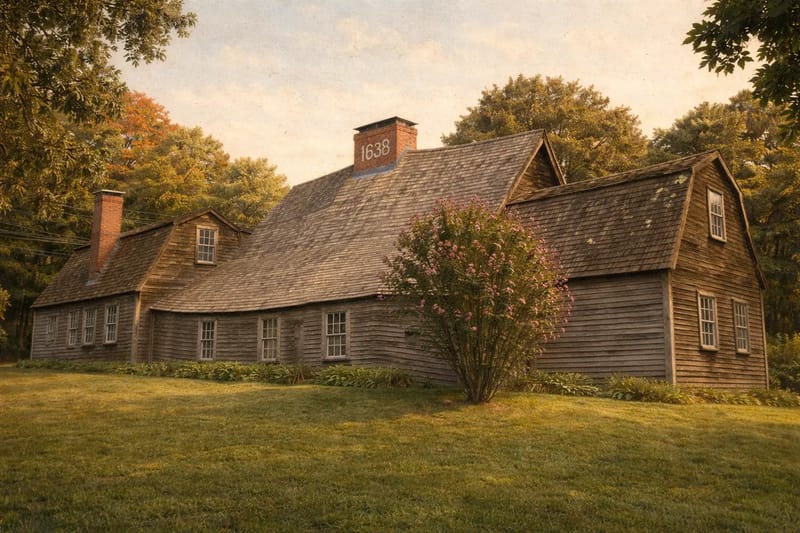

The Fairbanks Family in America (FFA) is a family association dedicated to the descendants of Jonathan Fairbanks, an early New England colonist whose family legacy is inseparably linked with one of the most important surviving structures of the seventeenth century. Founded in 1957, the society promotes historical scholarship, preservation, and public education relating to the Fairbanks family and early colonial Massachusetts.
Membership in the society is open to individuals who can document direct lineal descent from Jonathan Fairbanks, who settled in Dedham, Massachusetts, in the early years of the Massachusetts Bay Colony. The organization places particular emphasis on the preservation and interpretation of the Fairbanks House, a rare and exceptionally well-documented example of early colonial domestic architecture.
Jonathan Fairbanks
Jonathan Fairbanks was born in England around 1594 and immigrated to New England during the Great Migration, arriving in Massachusetts by 1633. He was among the early settlers of Dedham, a community established to the southwest of Boston as colonial settlement expanded inland from the coast.
Fairbanks became a landholder, farmer, and community member in Dedham at a time when the colony was still consolidating its social, legal, and religious institutions. Surviving town and land records place him firmly within the first generation of stable English settlement in the region. His life reflects the experience of many early Puritan colonists, combining agricultural labor with civic participation and religious observance.
Jonathan Fairbanks married Grace Smith, and together they raised a large family whose descendants spread throughout New England and, in later generations, across the expanding American frontier. Through these lines, the Fairbanks family became widely represented in colonial and early national America.
Fairbanks House
The Fairbanks House, constructed beginning around 1637, stands as the oldest surviving timber-frame house in North America. Built by Jonathan Fairbanks and expanded by successive generations, the house provides an extraordinary architectural record spanning more than three centuries of continuous family occupancy.
Unlike many early colonial dwellings that were lost to fire, redevelopment, or neglect, the Fairbanks House remained in the possession of Fairbanks descendants until the early twentieth century. This uninterrupted stewardship preserved not only the structure itself but also a layered record of domestic life, construction techniques, and adaptation over time. Architectural analysis of the house reveals early English framing methods, original seventeenth-century timbers, and later additions that reflect changing needs and styles across generations.
Today, the house operates as a museum and educational site, offering visitors a tangible connection to the lived experience of early New England settlers. Its preservation is central to the mission of the Fairbanks Family in America and serves as a focal point for public interpretation of colonial history.
Historical and Cultural Significance
The Fairbanks family occupies a distinctive place in American colonial history precisely because their story can be traced not only through documents but through a standing structure that survives substantially intact. The Fairbanks House allows historians, architects, and the public to examine early colonial domestic life in a way that few other sites permit.
For descendants, the house functions as more than an ancestral landmark. It is a material link to the conditions, skills, and choices that shaped early English settlement in New England. The continuity of occupation and adaptation embodied in the house underscores the long arc of family life in colonial and post-colonial America, moving from frontier subsistence to established community and, eventually, historical memory.