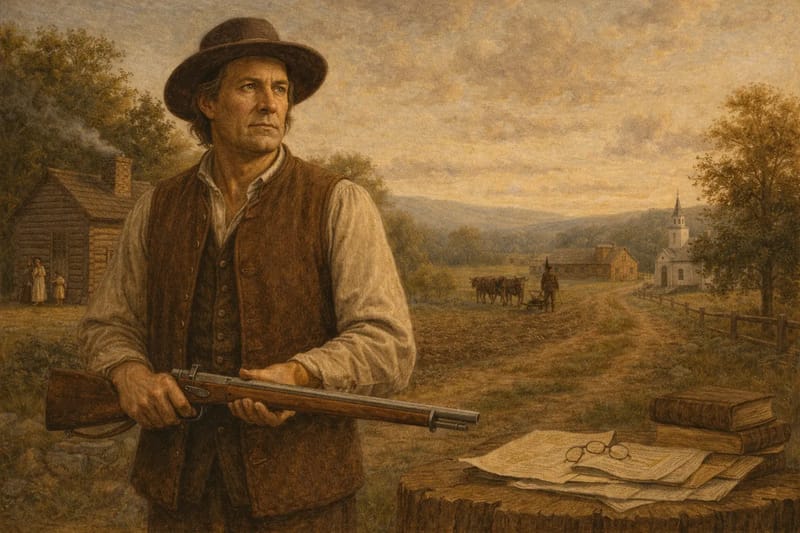

The First Families of Jackson County (Ohio) is a lineage society of the Jackson County Genealogical Society dedicated to recognizing descendants of individuals who resided in Jackson County on or before December 31, 1830. The society exists to preserve the documentary record of the county’s earliest families and to encourage careful, source-based genealogical research grounded in original records.
Membership is extended to applicants who can demonstrate direct lineal descent from a qualifying ancestor through a documented parent-child lineage. Proof is established through primary and secondary sources including census records, land transactions, probate files, vital records, and other contemporaneous documentation.
William Ray (1790-1843)
I am a member jure through William Ray (1790–1843), who resided in Jackson County, Ohio, by 1830. His presence in the county is confirmed by the 1830 federal census, placing him among the early settlers of the region during its initial period of organized settlement
William Ray’s life reflects the broader pattern of westward migration from North Carolina into Ohio in the early nineteenth century. He later died in 1843, leaving a documentary footprint that includes census, probate, and land records sufficient to establish both residence and continuity of family settlement. In addition to his civilian life, William Ray served in the Ohio Militia during the War of 1812, a fact documented independently and submitted separately to the General Society of the War of 1812. While military service is not a qualification requirement for First Families of Jackson County, it provides additional historical context for his residence and civic participation in Ohio during the early national period.
Membership in the First Families of Jackson County honors the men and women who established permanent communities in southern Ohio and contributed to the county’s early development. It also reflects a commitment to preserving the historical record through accurate documentation, transparent sourcing, and respect for archival standards, ensuring that early family histories are recorded with clarity and care for future scholarship.