
The First Settlers of the Shenandoah Valley (FSSV) is a lineage society that recognizes descent from individuals who settled in the Shenandoah Valley prior to 31 December 1779. The society preserves memory of the early colonial settlers who transformed the Valley from a contested wilderness into a productive agricultural frontier, and it documents the documentary evidence that connects their descendants to that founding generation. Membership requires proof of direct lineal descent and evidence of the qualifying ancestor’s presence in the Valley within the qualifying period.
William Saffer
My qualifying ancestor is William Saffer (also recorded as Safer and Saffron; born circa 1734, died before 12 January 1792 in Shenandoah County, Virginia), an early settler of the Shenandoah Valley whose land holdings are documented across multiple Lord Fairfax grants and Virginia county records spanning more than three decades. He is my eighth great-grandfather.
The documentary record for William is thin, as was typical for modest landholders of his era and region. No birth record survives, his parentage is unknown, and his wife’s name has not been recovered. What does survive is a paper trail of land and law that establishes him as a continuous and documented presence in the Valley from 1757 until his death.
The Northern Neck Proprietary and Lord Fairfax
To understand William’s land tenure, it is necessary to understand the unusual legal framework governing land in the northern Shenandoah Valley in the eighteenth century. The Northern Neck Proprietary, also called the Fairfax Grant, was a land grant first contrived by the exiled English King Charles II in 1649 and encompassing all the lands bounded by the Potomac and Rappahannock Rivers in colonial Virginia, constituting up to five million acres. By 1719, these lands had been inherited by Thomas Fairfax, 6th Lord Fairfax of Cameron. The Privy Council in 1745 secured the northern Shenandoah Valley to Fairfax, and he returned permanently to Virginia in 1747, building an estate known as Greenway Court in what is now Clarke County.
The practical consequence for settlers like William was that acquiring legal title to land in the Valley required dealing with Lord Fairfax’s land office rather than with the colonial government in Williamsburg. Fairfax issued grants in exchange for quit-rents, the modest annual payments that constituted the proprietary’s revenue. A Fairfax grant was not merely a purchase; it was entry into a feudal-adjacent system of tenure that defined land ownership in the Valley until the Revolution rendered the proprietary defunct.
Land Grants and Settlement
William Saffer received a land grant of 249 acres in 1757 in Frederick County, Virginia. His land was located in the Scotch-Irish settlement area of Frederick County, with surveys for his tract located adjacent south of Overall, referred to as Over Run or Caleb’s Run. This initial grant establishes his presence in the Valley by 1757 at the latest and provides the basis for his qualification as a First Settler. The application record for this membership cites Doc. 49, a land grant to neighboring settler Shadrack Parlour from Lord Fairfax dated 1760, and Doc. 50, the 1771 Fairfax grant to William himself, together confirming his continuous foothold in the region across those years.
The 1771 grant represents a second, or supplemental, acquisition and confirms that William remained an active landholder in the Valley well into the period leading up to the Revolution. By this point the county structure had been reorganized, and what had been Frederick County was gradually subdivided; the area near Caleb’s Run eventually fell within Shenandoah County, where William’s estate would be probated two decades later.
An 1778 deed records that Adam Cunningham obtained land adjacent to William Saffer’s holdings and that of Ephraim Leith, placing William among an identifiable cluster of neighboring landholders in the South Fork region. This is precisely the kind of incidental mention that anchors a lightly documented ancestor in the local geography and confirms that his land was occupied and known to his neighbors well into the Revolutionary period.
The Census Records of 1783 and 1785
William appears in two enumeration records that bracket the end of the Revolutionary War. He was included in the 1783 Hite enumeration as head of household, and in the 1785 enumeration census as head of family with seven people in one dwelling, as recorded in A History of Shenandoah County by John W. Wayland. Seven persons in a single household in 1785 is suggestive of a multi-generational or extended family structure, though the individual members cannot be identified with certainty from the enumeration alone. It confirms, however, that William survived the Revolution and remained resident in Shenandoah County with a substantial household at that date.
The Estate of William Saffer
William died sometime before 12 January 1792, when his estate was inventoried in Shenandoah County. His probate appears in the Virginia Wills and Probate Records, Will Book Vol. C (1790-1791) and Vol. D (1791-1796), with the probate date recorded as June 1792. The application for this membership cites Doc. 46, the inventory of William Saffer’s estate dated 1792, and Docs. 47 and 48, respectively a decision and a pleading in the cases of John Overall v. Heirs of William Saffer (1815) and Isaac Overall v. Heirs of William Saffer (1823). That litigation persisted for more than three decades after William’s death, indicating that his estate included land of sufficient value to generate sustained legal dispute, and that his heirs were known and present in the county.
The surname Overall in both suits is not coincidental. William’s land was situated near Overall Run, and the Overalls were neighboring landowners. The protracted litigation suggests a boundary or title dispute of the kind common to land granted under the Fairfax system, where surveys were sometimes irregular and adjacent claims overlapping.
Daughter Hester Ann Saffer
The only child of William’s identified in the available record is Hester Ann Saffer, born before 12 January 1792 in Shenandoah County, Virginia, who married Peter Lynch (1751-1823) in the Shenandoah Valley in 1776. Through Hester Ann and Peter Lynch, the descent passes to Tellitha Lynch, then to Andrew and Sophia Baumgardner, and onward through the Bunnell and Williams lines to the present day.
The Daughters of the American Revolution have recognized William Saffer under patriot number A211754, which is the basis for the WikiTree citation. This DAR recognition is consistent with the land and census record evidence placing William in the Valley throughout the Revolutionary period, though the precise nature of his service or loyalty documentation in the DAR file has not been independently reviewed.
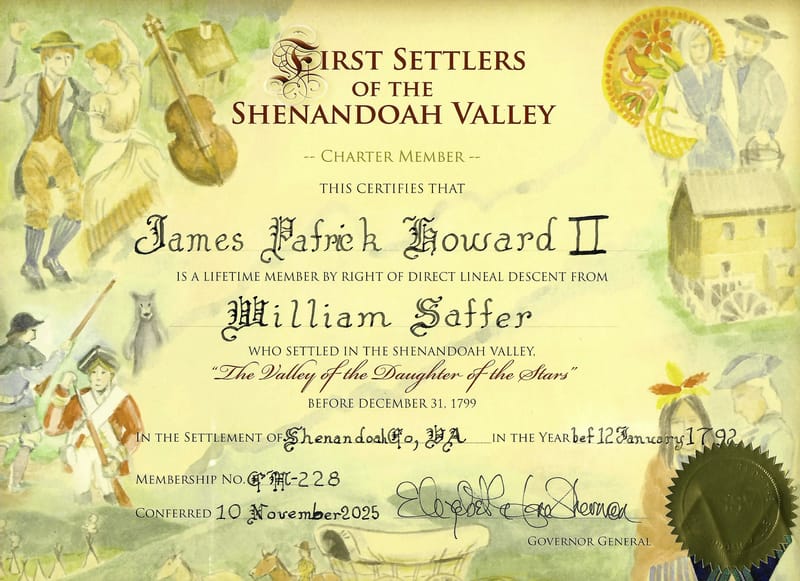
Or you can download the PDF here.
Additional memberships will be added as they are approved.