
I am pleased to say that I have recently been accepted into the Order of Americans of Armorial Ancestry (OAAA). For those unfamiliar, this is a lineage society devoted to Americans who can demonstrate descent from an ancestor who bore a coat of arms under European heraldic law. That may sound niche, and it is, but it is also one of the most intellectually satisfying affiliations I have taken on. Among lineage societies, this may be the only one where it makes sense to add every eligible supplemental you can document. Each one is not just another name on a tree, but a legal affirmation of inherited heraldic rights. There is something compelling about that: a record of ancestral identity, codified in color and symbol, across borders and generations.
The OAAA was founded in 1903, during the golden age of American lineage societies, by a small group of genealogists and heraldic enthusiasts led by Mrs. William Gerry Slade. Unlike many of its contemporaries, which center on military service, colonial governance, or royal ancestry, the Order is unique in its singular focus: membership is limited to Americans who can prove descent from an ancestor who bore a coat of arms under the rules of recognized heraldic authorities in Europe.
That is not as esoteric as it might sound. Armorial descent simply means that one of your forebears had a lawful right to a heraldic device, and that you can document both that right and your connection to it, generation by generation. It is less a matter of nobility than of record-keeping. As with most things genealogical, eligibility begins with a long paper trail, and ends with a long application form, a check, and a brief wait while someone else checks your work.
It is worth pausing here to make a critical distinction: coats of arms do not belong to surnames. They are not family logos floating freely in the ether, waiting to be claimed by anyone who happens to share a last name with the original bearer. Heraldic arms are granted to individuals, not lineages, OAAA and their use is governed by systems of entitlement. In England, that means a grant or confirmation by the College of Arms; in Scotland, a matriculation through the Court of the Lord Lyon; elsewhere, a host of other national authorities maintain or maintained their own rules.
Even in countries without active heraldic offices, entitlement has legal meaning in its historical context. To claim an armorial inheritance, then, is to assert descent from a particular individual with a documented right, not merely to share their name, but to share their blood. The Order of Americans of Armorial Ancestry rests on that principle. A member does not inherit a symbol because it is decorative or resonant, but because it was lawfully borne by someone whose life intersects their own, generation after generation, without a break.
This is more than a theoretical point. My surname is Howard, and the Howard arms, most famously those of the Dukes of Norfolk, are among the best-known in English heraldry. But I cannot, as of yet, prove a line of descent that would entitle me to bear them. To use those arms without that proof would not be a harmless expression of heritage. It would be, in heraldic terms, a kind of identity theft: the appropriation of a symbolic claim to which I am not entitled. That is why documentation matters, and why the Order insists on it.
At first glance, the idea of heraldic lineage might seem like an awkward fit for citizens of a republic. The United States Constitution contains no provision for coats of arms, let alone for noble titles, peerage, or inherited privilege. The founders were quite deliberate in excluding such things. And yet, Americans have long been fascinated, one might say quietly obsessed, with coats of arms. Even if our popular understanding rarely gets past novelty plaques and family crest coffee mugs, the attraction persists. This is not just kitsch. It reflects a cultural memory: a lingering awareness of British, Irish, and Continental European ancestry, where heraldry once served as a legal and social identifier.
In that context, arms were not symbolic flourishes but a kind of bureaucratic shorthand, used in seals, wills, military commissions, and land conveyances. In America, that juridical function has faded, but the appeal has not. Here, heraldry is less about law and more about aspiration. It gestures toward continuity, identity, and a deeper sense of belonging, not necessarily to a class, but to a story. And for all our protestations, Americans have never really turned away from heraldic imagery. One of the most recognizable coats of arms in the world is the Great Seal of the United States: an eagle bearing a shield, clutching arrows and an olive branch, surrounded by stars. We may not call it heraldry, but we instinctively understand what it is for.
The OAAA sits comfortably among is siblings socities: Sons of the American Revolution, the General Society of the War of 1812, and the Order of the Founders and Patriots of America, and others of that ilk. All draw their appeal from a similar source, a desire to locate oneself in a story larger than individual striving. These organizations offer a framework of continuity, a link to people and places that predate the republic itself. But while many such societies revolve around martial service, colonial governance, or royal lineage, the armorial societies make a subtler claim. They are not about what your ancestors did, but what they were entitled to bear. The right to a coat of arms is not a narrative of action, but a statement of identity. It is an abstract credential, yes, but also a personal one, inherited in name, in blood, and, at least symbolically, in honor.
There is a seriousness to it. Applications are vetted, pedigrees scrutinized, and heraldic entitlements evaluated with care. This is not costume drama for antiquarians, nor is it a club for those content to misread clip art. Many members of the Order are students of heraldry in the technical sense: they understand blazon as a formal language, recognize the rules of marshalling, and can speak fluently about the significance of tinctures, ordinaries, and charges. The Order holds meetings, issues insignia, and occupies a corner of American genealogical life where ceremonial decorum still matters. Ribbons are worn correctly. Medals are displayed according to precedence. The symbolism is not ironic. It is earned.

Why, then, do Americans do this? What compels the citizen of a nation founded in rebellion against crowns and quarterings to seek connection to a forebear granted a coat of arms by the College of Arms, the Lord Lyon, or some long-abolished heraldic court? In my case, the answer is a man I had never heard of until I began this process: John Hoar of Massachusetts. He was not just a name in a pedigree chart. He was a seventeenth-century lawyer of formidable reputation, a negotiator with Native nations during some of the most fraught years of colonial conflict, and a political figure whose legacy is only now beginning to receive the attention it deserves. His legal work was grounded in principle rather than expediency, and his diplomacy during King Philip’s War helped secure the release of captives when cooler heads were in short supply. He was, by the standards of his age or any other, impressive.
Before I undertook this research, I knew nothing of John Hoar. I had no reason to suspect that a colonial lawyer from Concord would emerge from the archival dust bearing a double-headed eagle and a long record of honorable service. And yet here he is, standing at the head of a line that leads, eventually, to me. This is what heraldry makes possible: not just the recovery of facts, but the restoration of meaning. That eagle is not just a motif. It is a sign that someone, long ago, stood for something, and that their descendants have not entirely forgotten how to look up.
There is, of course, a certain irony in all of this. The mottoes are in Latin, the arms are drawn from European systems of nobility, and the whole affair carries the scent of old vellum and red sealing wax. But paradoxically, that is what makes it so American. No one is born into the Order by legal right or feudal custom. One must choose to seek the past, to gather the evidence, to make the case. In that sense, it is an act not of inherited privilege, but of civic intention. It reflects the American habit of assembling identity from fragments, by choice, by effort, and, in this case, by affidavit. It is heraldry in the key of democracy: self-affirmed, painstakingly documented, and voluntarily upheld.
We remain, as ever, a nation that claims to scorn titles while founding clubs to celebrate them. The OAAA is less a contradiction than a reflection, not of aristocracy, but of our peculiar national way of engaging with the past. We want the pageantry without the privilege, the symbolism without the structure, the heraldry without the herald. And in the end, that is exactly what we have created: a republic where memory is optional, but all the more powerful for being chosen.
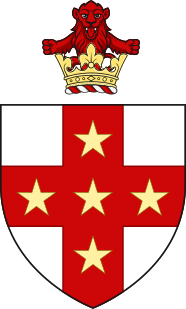
My first supplemental application to the Order, in right of Henry Adams of Braintree, Massachusetts, has now been accepted. He is widely identified in colonial sources as bearing Argent, on a cross Gules, five mullets Or, a bold and ecclesiastical design that appears frequently in early American heraldic literature. Since that success, I have submitted supplemental applications for four more ancestors, each with their own distinct arms and histories. The process is meticulous, yes—but also deeply rewarding. Each submission is not just a claim, but an act of preservation, a restoration of identity one shield at a time.