
The early Chesapeake was shaped by a wide cast of settlers, from landed gentry and indentured servants to Puritan merchants and opportunists. Among the names that recur in seventeenth-century Virginia and Maryland is Matthew Howard (1600s–1650s), an immigrant whose children helped anchor settlement on the Severn and left a mark on provincial life.
The first clear notice of Howard appears in February 1637, when a land patent to Robert Taylor described Taylor’s 100 acres as bounded on the west by land of Matthew Howard. By August 1638, King Charles I granted Howard 150 acres in Elizabeth City County for the “adventure” of his wife Ann and two white servants. Under Virginia’s headright system, planters received fifty acres for each person whose passage they financed. The grant places Howard among those with the means to move dependents and labor across the Atlantic. His lands adjoined properties of families such as the Lloyds, Sandys, and Willoughbys, a reminder that settlement proceeded through networks as much as through maps.
Howard’s origins remain uncertain, but his associations are not. He lived among the Puritan community in colonial Virginia in Lower Norfolk and had close ties to Edward and Cornelius Lloyd, influential merchants and planters. Tension with Virginia’s established Anglican authorities sharpened in the 1640s. When Cecil Calvert invited the Puritans to Maryland, where toleration for Christians had firmer footing under the 1649 Act Concerning Religion, many packed up and crossed the line. Howard went with them.
Matthew’s wife is usually identified as Ann. In 1645, proved 1648, Richard Hall of Lower Norfolk left his estate to the children of Matthew and Ann Howard and named Matthew executor. The bequest implies a strong relationship. Some have inferred that Ann was Hall’s niece, Ann Hall; the record does not prove it. What the will does show is Howard’s standing and the trust he commanded among neighbors. A brief abstract of Richard Hall’s will records the bequests.
The children most commonly attributed to Matthew and Ann are:
- Samuel Howard (c. 1628–1703). Married Catherine Warner, daughter of James Warner and Elizabeth Harris. He held land in Anne Arundel County and served as a justice of the peace. His descendants intermarried with the Dorsey, Ridgely, and Warfield families.
- John Howard (c. 1630–1696). Married Mary (surname uncertain), later Juliet Warfield. He lived at Round Bay on the Severn, served in the militia, and sealed his 1695 will with the undifferenced Howard arms, a point later pressed by those arguing for noble descent.
- Cornelius Howard (c. 1635–1680). Likely named for Cornelius Lloyd. Married Elizabeth, possibly a daughter of John Todd. By 1660 he held land in Anne Arundel County; in 1679 he sold “Howard’s and Porter’s Range” to Adam Shipley. His tract “Howard’s Hope” appears in the Maryland Calendar of Wills.
- Philip Howard (d. 1705). Married Sarah (surname uncertain). His holdings included tracts known as Warner’s Neck and Howard’s Inheritance.
- Matthew Howard Jr. Records are thin. Some researchers believe he died young or remained in Virginia.
- Mary Howard and Anne Howard. Both married into neighboring families; documentation is scattered.
By 1649, enforcement of Anglican conformity in Virginia had intensified. The Puritan migration to Maryland gathered force, and Howard settled with the Lloyd party on the Severn near the town of Providence, the site of modern Annapolis. A survey dated 3 July 1650 noted land laid out for Matthew Howard on the south side of the Severn near Marsh’s Creek, about 350 acres, and another tract of roughly the same size running with Howard’s Swamp; occupation often preceded patent, and the 1650 survey certificate preserves the survey language.
Howard died between 1658 and 1659. His name falls out of the record just as his sons begin to patent and convey the Severn lands. John, Samuel, and Cornelius secured tracts that came to be called Howard’s Inheritance, Howard’s Heirship, and Howard’s Hope, and added acreage through headrights and purchase. By the 1670s the family controlled substantial ground around Round Bay.
The pattern of life that frames these choices is familiar. Tobacco drove the Chesapeake economy, and the headright system rewarded anyone who financed the passage of family, servants, or tenants. Planters like Howard also grew maize and beans, kept cattle and hogs, and traded surplus along the waterways. Labor needs were heavy. Indentured servants supplied much of it in the 1630s and 1640s, with enslaved Africans forming a growing share by century’s end in colonial Virginia. Religious life and politics were deeply entangled. Sir William Berkeley’s return to the Virginia governorship in 1642 brought stricter conformity. Disarming Puritan militia and expelling their ministers pushed dissenters toward Maryland, where the 1649 Act of Toleration offered a safer berth as Puritan congregations in Virginia faced disarmament and expulsion. Howard’s move fits that current.
On questions of religion, the available evidence points to Puritan alignment rather than to Anglican or Catholic identity. Howard migrated with the Lloyds and settled at Providence, a Puritan enclave. There is no record of recusancy fines for him or his sons.
Howard’s children helped turn surveys into a settlement. Samuel repeatedly served as a justice of the peace, sat on juries, and handled routine county business. John was active in the militia and appears in civic matters along the Severn. Cornelius acquired and traded land, later reaching into what became Baltimore County. Through marriages into the Warner, Ridgely, Warfield, Chew, Todd, Dorsey, Worthington, Worthington-adjacent, and other families, the Howards extended their network across central Maryland. Within a generation, they had ties to the assembly, to parish vestries, and to merchant ventures in Annapolis.
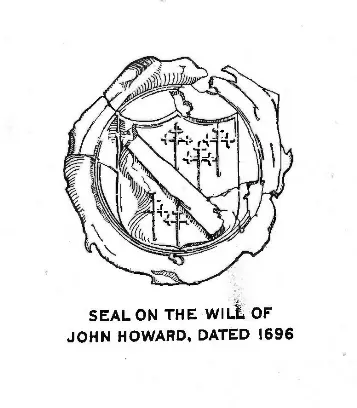
One artifact has drawn perennial interest: the seal on John Howard’s 1695 will. Fredric Z. Saunders notes that the wax shows the Howard arms, “gules, a bend between six cross-crosslets fitchée argent,” without the Flodden augmentation later borne by the ducal line. Colonial gentlemen sometimes adopted prestigious arms without legal right, so the seal does not prove descent. It does, however, show how identity and aspiration were expressed in the colony.
Matthew Howard’s appeal lies less in conjectured ancestry than in the record of what he and his children did. He arrived in Virginia with enough resources to claim land, built alliances with influential neighbors, moved to Maryland when policy and conscience pointed that way, and left children who served, traded, and married their way into the province’s fabric. The names of their tracts, the appearance of their signatures on county business, and the persistence of their kin across Anne Arundel and beyond tell that story plainly. Whatever the fog around his birth, the life that can be documented is the one that matters here.