
One of the interesting things about genealogy is that the records do not always preserve the things we would expect them to. We can spend hours piecing together where someone lived, when they married, and what happened to their property after they died. Sometimes we get lucky and find a letter or a diary that tells us what the person thought. More often, we learn what the person did, usually because somebody needed to write it down for legal or administrative purposes. And every so often, what somebody needed to write down turns out to be rather peculiar.
Robert Willson, one of my colonial American ancestors, was a Quaker born in Scarborough, Yorkshire, around 1650. He moved to West Jersey in the early 1680s and settled near Crosswicks Creek in what became Burlington County, New Jersey. He appears in Quaker meeting records, land transactions, and the records of the colonial government. He served as a constable and later sat in the General Assembly of West Jersey in 1696 and 1697. Those are the sorts of things I was expecting to find when researching his life. What I was not expecting was a description of how he cut the ears of his livestock.
In Richard Eugene Willson’s The Willson Family, 1672–1959, the author cites the Burlington County records, volume II, page 10, for this entry:
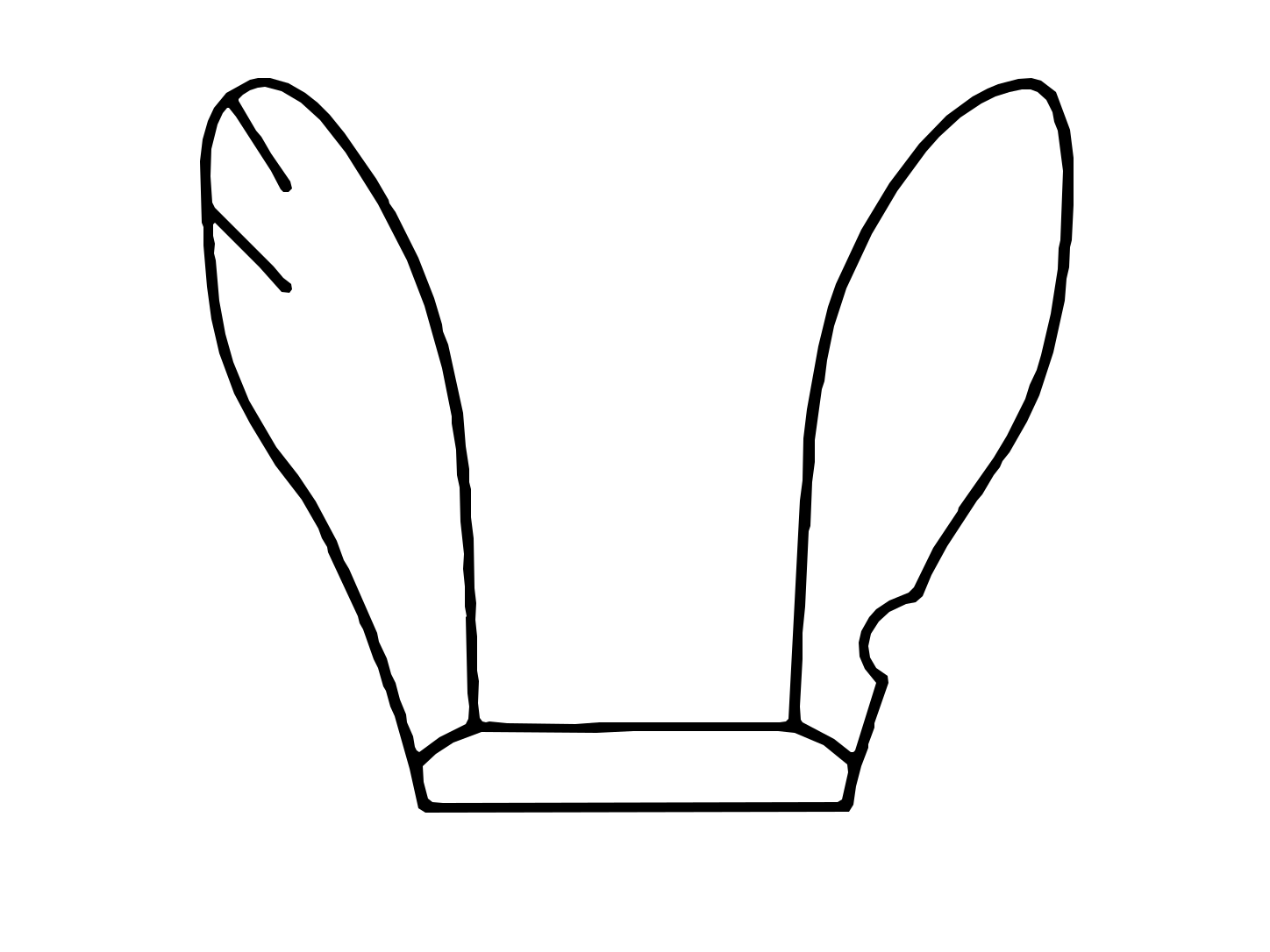
Ear marks: Robert Willson: Right ear, two slits, ye left under-cut next ye head.
There it is. More than three hundred years after Robert’s death, we know that his animals had two slits in the right ear and an undercut near the head on the left. I cannot say which of his animals actually wore this distinctive arrangement, or whether he ever had to use it to recover a wandering cow. But someone considered the information worth recording, and someone else considered it worth copying into a family history.
The explanation is quite practical. Livestock in colonial America did not necessarily spend their lives behind fences. Animals could graze in woods or on common land, and hogs in particular could forage for food without having a farmer watching them every minute. This was an economical way to feed animals, but it introduced an obvious problem. If your hog wandered off and joined your neighbor’s hogs, how could either of you tell which one belonged to whom? A cow cannot tell you who owns it, and livestock are not particularly interested in respecting property boundaries.
One solution was to mark the animal’s ears. A farmer could cut slits, remove the tip of an ear (a crop), or cut a notch from its upper or lower edge. By combining different cuts on the right and left ears, and varying their positions, a substantial number of distinct patterns became possible. These marks remained visible as the animal grew. The idea was not to decorate the livestock, which almost certainly had no opinion on the matter, but to make ownership recognizable when the animals wandered away from home.
Of course, the system only worked if two neighboring farmers did not use the same pattern. It was not enough for Robert to recognize his own animals; a neighbor finding one of them needed to recognize Robert’s mark, too. Consequently, these designs were entered into registers. Across the Delaware River, Phineas Pemberton began recording the ear and brand marks of Bucks County livestock owners in 1684. The surviving book contains more than a hundred entries, including one for William Penn. Penn’s cattle had both ears cropped, and his brand included initials identifying him as proprietor and governor of Pennsylvania. Apparently, governing a colony did not relieve him of the ordinary difficulties of keeping track of cows.
The Bucks County register also tells us what these records looked like. It did not merely list owners and written descriptions. It included schematic drawings of the forehead and ears of a cow facing the person examining it. The outlines were drawn in black, while the cuts could be indicated in red. William C. Armstrong described these drawings in his 1902 history of the Lundy family, which reproduces the registered mark of Richard Lundy. It is not a portrait of a cow. It is a way to show precisely where the cuts belong, with everything unnecessary left out.
The relationship to heraldry is rather hard to miss. A coat of arms is specified through a blazon, a verbal description of the shield and its charges. The same blazon can be illustrated by different artists, sometimes in quite different styles, without changing which arms are being represented. The written description is the important thing; the particular drawing is an expression of it. Robert Willson’s entry works in much the same way. Someone who understood the vocabulary of earmarks could read those few words and know how the owner’s animals were supposed to be marked.
This comparison is not entirely new. In a paper on the original seal of Bucks County, published in A Collection of Papers Read Before the Bucks County Historical Society, Judge Harman Yerkes described the county’s livestock-mark register as an example of “primitive heraldry.” He had been examining official seals and other identifying devices, and the earmarks struck him as belonging to the same general family of practices. It is a lovely observation, especially because the examples were not coats of arms in the usual sense. They were marks used by ordinary farmers for a very ordinary purpose.
There are limits to what Robert’s particular record can tell us. I have the description as reproduced in the family history, rather than a verified image of the original entry. The illustration here is therefore a modern interpretation, based on the words and on the general form of surviving colonial earmark drawings. We do not know exactly how far apart the two slits were, or precisely how the undercut was shaped. If the original Burlington entry turns up with a drawing, the reconstruction may need to be corrected. That seems preferable to pretending a modern sketch is a seventeenth-century artifact.
What interests me most, though, is the odd intimacy of the record. Robert’s land deeds tell me where he lived and what he owned. The Quaker minutes tell me something about his place in the community. His service in the Assembly tells me he had a role in the government of West Jersey. The earmark tells me what one of his neighbors might have looked for when a stray animal appeared on the wrong side of the creek. It is a small detail, but it puts Robert back into the daily business of living.
We tend to remember our ancestors through births, marriages, deaths, and whatever public achievements happened to leave a trace. Robert Willson also had animals to manage, neighbors to deal with, and a reason to put two slits in the right ear. Three centuries later, that little piece of practical bookkeeping has become one of the more interesting things I know about him.