
One of the interesting things about having a coat of arms is that it can be illustrated in an almost unlimited number of ways. Since receiving my grant of arms from Malta in 2024, I’ve assembled a collection of interpretations by heraldic artists from different traditions. Some are elaborate illustrations, with intricate mantling, detailed helmets, and carefully shaded charges. Others are comparatively simple, using solid colors and geometric shapes. Yet every one represents the same coat of arms.
Consider these two interpretations of my arms, one by Dr Antonio Salmerón and the other by C. Sobrino-Pedrido.

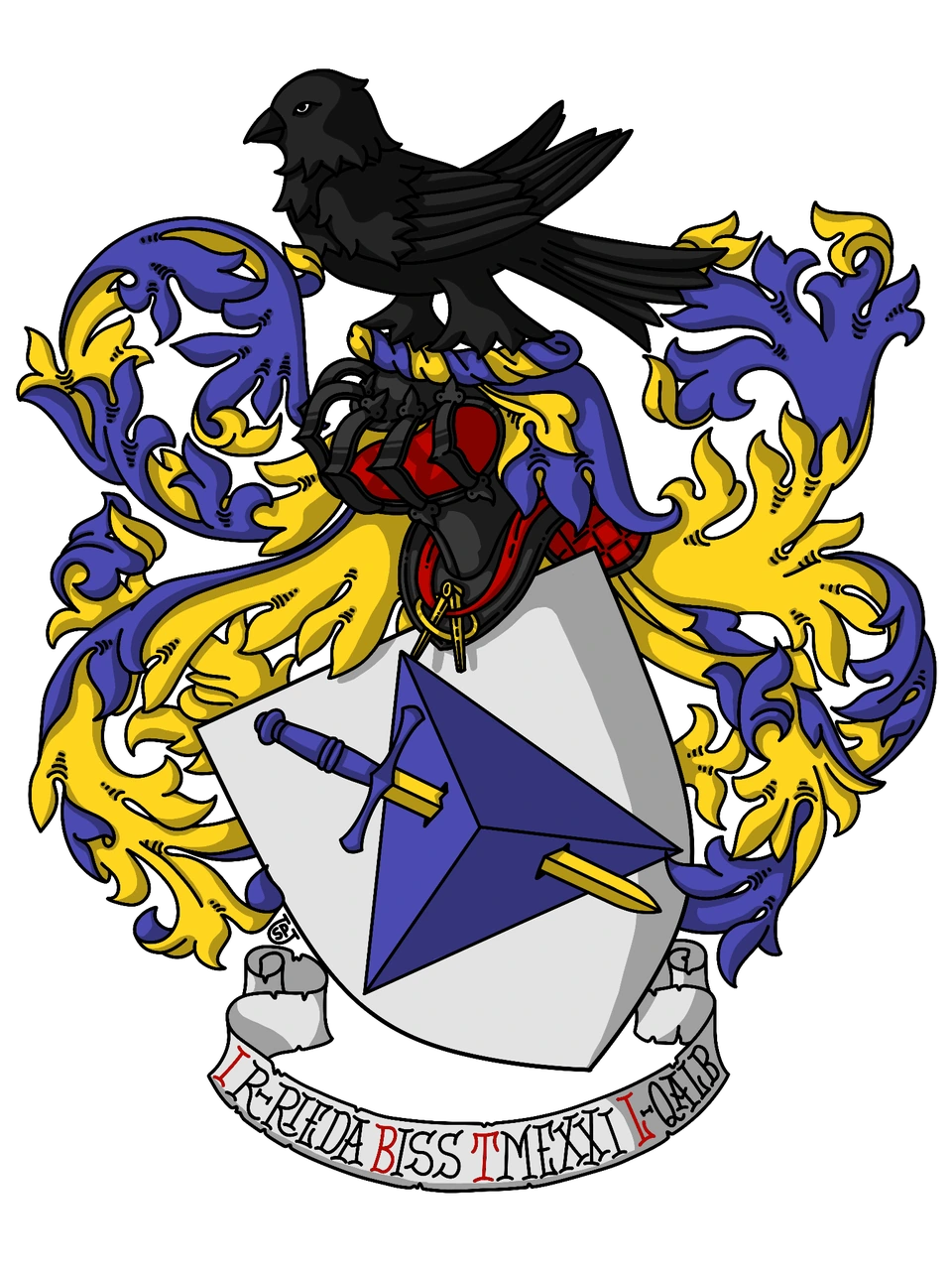
There are substantial differences between the two. The helmets differ in construction and ornamentation, the mantling follows different patterns, and the martlet, the black bird serving as my crest, looks considerably different. Even the tetrahedron on the shield differs in its perspective and shading. If we were comparing these as ordinary illustrations, we would probably say they depict the same subject in different artistic styles.
But heraldry makes a more interesting distinction. They are not merely two pictures of the same coat of arms. They are two emblazonments of the same arms, and neither particular drawing is necessary to establish the heraldic identity.
To understand why, we need to look at how heraldry describes a coat of arms in the first place.
The Blazon
A blazon is the formal description of a coat of arms using the specialized language of heraldry. Rather than specifying exactly what the picture should look like, the blazon establishes the essential properties of the design. It identifies the colors, charges, positions, and relationships that distinguish one coat of arms from another. The College of Arms Foundation’s explanation of heraldic language describes the blazon as the written legal description of the arms and the guidance from which an artist may produce an illustration.
The English blazon recorded with my Maltese grant reads:
Argent in pale a tetrahedron Azure pierced in bend by a sword Or with pommel and cross piece of the Second. Upon a helm befitting his degree with mantling Azure and doubled Or is set for crest, upon a wreath of the liveries a martlet Sable.
To someone unfamiliar with heraldry, this probably looks like someone took a perfectly reasonable English sentence and made it unnecessarily difficult to read. But the language is remarkably compact, and each part carries specific information.
The shield has a silver field, known as Argent. Upon that field is a blue tetrahedron, or Azure, pierced diagonally by a gold sword, or Or. The sword has a blue pommel and crosspiece. The reference to “the Second” is a shorthand referring back to Azure, the second tincture named in the description. The traditional terminology for colors, metals, and the geometric arrangements of heraldic charges is summarized in English Heritage’s introductory guide.
Above the shield is a helmet with blue and gold mantling. Upon a wreath of the same colors stands a black martlet, described as Sable.
Those properties establish the design. An artist cannot arbitrarily change the sword from gold to silver, replace the tetrahedron with a pyramid of a different geometric form, or substitute a raven for the martlet and still claim to have followed the blazon. Those would be changes to the heraldic design itself.
But the blazon says nothing about the exact dimensions of the shield, the angle from which the tetrahedron should be viewed, or the particular curves in the mantling. It does not specify whether the bird should look realistic or highly stylized. The artist must make those decisions.
This is where the distinction between the blazon and the emblazonment becomes important.
One Specification, Many Interpretations
We can think of the blazon as something like a formal specification in engineering or computer science. A specification establishes requirements that an implementation must satisfy, but it does not necessarily determine how the implementation must be constructed.
Consider a software interface that defines a function accepting two numbers and returning their sum. We could implement that interface in Python, C, JavaScript, or any number of other programming languages. The underlying implementation might differ substantially, but the contract remains the same. If one implementation starts subtracting the numbers, it no longer satisfies the specification.
Heraldry works similarly, although the specification is visual rather than computational.
The blazon establishes the constraints, while the emblazonment is the artist’s realization of those constraints. The artist has considerable freedom, provided the finished artwork continues to represent the arms described. Indeed, the Canadian Heraldic Authority’s guidance on artistic production specifically recognizes that painters can select the shape of the shield, the style of helmet, and the treatment of mantling to create an individual interpretation of a heraldic design.
This is especially apparent when we consider my tetrahedron. A tetrahedron is a mathematical object, a polyhedron with four triangular faces, six edges, and four vertices. Those properties do not change when we rotate it. However, when we draw a tetrahedron on a two-dimensional surface, we must choose a projection. We must determine which faces are visible, how the edges appear, and whether we want to use shading to suggest depth.
None of those choices changes the geometry of the tetrahedron. We can produce many different drawings of the same mathematical object, some of which may look quite different.
Now consider the interpretation by Alexandr Chernushkin.

Chernushkin’s interpretation makes extensive use of ornamentation and shading, particularly in the mantling and the rendering of the tetrahedron. The visual effect is substantially different from Salmerón’s interpretation, even though the essential elements are retained. We still have a silver shield, a blue tetrahedron pierced by a gold sword, blue and gold mantling, and a black martlet.
That consistency is what makes both images representations of the same arms. We do not need the tetrahedron’s faces to have identical angles on the page, nor do we need the mantling to reproduce the same folds. Indeed, requiring those details would eliminate much of the artistic freedom that makes heraldic illustration interesting.
The distinction extends to color. Azure means blue, but it does not ordinarily mean a particular numerical color specification. The Heraldry Society’s guidance on tinctures recognizes that the precise shade is generally up to the artist, provided the heraldic color remains identifiable. The College of Arms similarly explains that there are no fixed Pantone specifications for heraldic tinctures. An artist might use a deep royal blue, another a lighter blue, and another a richly shaded combination of both. All can represent Azure.
This is rather different from the way modern corporate identity systems often work. A corporate brand guide may specify precise colors, dimensions, clearances, and permissible arrangements. The object is to ensure that a logo looks substantially the same wherever it appears. Heraldry generally preserves identity through specified heraldic properties rather than requiring identical reproduction of a particular drawing.
The Picture Is Not the Identity
There is another implication of this distinction that becomes apparent when we remove color entirely.
Heraldry developed conventions for representing tinctures through patterns of lines and dots, commonly called hatching. With hatching, a coat of arms can be represented in black and white while still communicating the colors of its charges. The Heraldry Society’s introductory handbook describes this system and its use on materials where pigments were unavailable or impractical, including parchment, stone, and engraved surfaces.
I have made a hatched rendering of my own arms.

The absence of blue and gold pigments does not mean the heraldic colors have changed. Instead, the hatching encodes those colors through a different visual convention. Someone familiar with the system can reconstruct the intended tinctures without ever seeing a color illustration.
This is rather remarkable. We have taken an image, removed its colors, replaced them with patterns, and preserved the information necessary to identify the same arms. The result is not a new coat of arms, even though the drawing looks different.
In mathematical terms, we can think of these representations as belonging to an equivalence class. The images differ in appearance, but they share the properties necessary to represent the same heraldic identity. We are not asserting that every pixel, line, or artistic decision is equivalent. We are asserting that the differences do not change the defining heraldic properties.
This also explains why the physical shape of a shield is not necessarily part of the identity. A coat of arms might appear on a medieval heater shield, a Renaissance cartouche, a circular seal, or a modern digital illustration. In ordinary circumstances, the shield’s outline is an artistic choice rather than an essential component of the blazon. There are exceptions, particularly where a particular form carries a specific heraldic meaning, but the underlying principle remains.
We can even remove the helmet, mantling, and crest when displaying the shield alone. The shield continues to bear the arms, even though it no longer shows the complete achievement. This is a distinction worth preserving, since a coat of arms is commonly, and incorrectly, referred to as a crest. The College of Arms is particularly clear that a crest is one component of the achievement, ordinarily displayed above the helmet, rather than a name for the entire composition.
The Limits of Artistic Freedom
Of course, this does not mean that an artist may draw whatever they please.
A blazon is supposed to preserve enough information for the arms to be reconstructed consistently by someone who understands heraldic conventions. If an artist changes an essential characteristic, we no longer have a faithful interpretation. The difficulty lies in determining which characteristics are essential and which are matters of artistic convention.
Some of these decisions are straightforward. Replacing the gold sword with a silver sword would alter a specified tincture. Changing the sword’s orientation could alter a specified relationship. Replacing the martlet with a different bird would change the crest.
Other cases are less obvious. How much can we change the shape of a charge before it becomes something else? Does a particularly unusual style of helmet imply a rank or status that the bearer does not possess? Can an artist add supplementary insignia without implying that they were part of the original grant? These questions depend partly upon the rules and conventions of the particular heraldic tradition. The American Heraldry Society’s guidelines for heraldic practice provide a useful discussion of the distinction between conventional heraldic composition and designs that depart too far from those conventions.
Even the treatment of helmets illustrates why we have to be careful. The Canadian Heraldic Authority generally treats the helm and mantling as decorative elements, deliberately avoiding helmet conventions that signify particular ranks in other traditions. A style that is entirely appropriate in one heraldic setting might suggest something rather different in another.
And there’s a particularly useful illustration of the distinction between description and artwork in Malta itself. The Office of the Chief Herald of Arms of Malta offers grants and registrations with a blazon alone, with artwork prepared by the Office, or with artwork supplied by the petitioner. The distinction is significant because the formal heraldic description can exist independently of a particular commissioned illustration. The painting is not necessarily the only means by which the granted design can be recorded or recognized.
This does not make heraldry into a programming language, nor does it mean every heraldic institution interprets the relationship between written and pictorial records identically. Heraldry is a historical and social system, with conventions developed across different jurisdictions over centuries. But the ability to distinguish a design from its particular artistic representation is one of the properties that has allowed it to survive those differences.
Why This Matters
One of the practical advantages of this system is that a coat of arms can persist through changes in artistic technique and technology. A medieval heraldic artist could paint a design on parchment, while a modern artist might render the same design using vector graphics. A woodcarver, embroiderer, engraver, and digital illustrator can all work from the same blazon without requiring an exact reproduction of an earlier picture. The Heraldry Society’s discussion of the herald painter provides examples of how different materials, from engraved silver to bookplates and seals, impose different artistic requirements upon the same heraldic design.
The result is a system of visual identity that is surprisingly independent of any particular medium.
This is also why I enjoy collecting different interpretations of my own arms. Each artist brings something different to the work. Some emphasize the geometry of the tetrahedron, others the texture of the mantling or the posture of the martlet. I have my preferences, naturally, but those preferences do not determine which interpretations are heraldically legitimate.
The artists are not merely copying a picture. They are applying a shared descriptive language to produce their own representations of a design.
And that brings us back to the distinction between the blazon and the emblazonment. The blazon provides continuity, while the artwork permits variation. The arrangement allows a coat of arms to remain recognizable even when the conventions of illustration, the available materials, and the preferences of the artist change.
The picture may belong to an artist, an era, or a particular medium. The heraldic identity is something that persists across them.