
Spend a little time looking at German coats of arms and you will start noticing the horns. They rise from the helmets above the shields, usually in pairs, sometimes enormous, and frequently striped or decorated with feathers. Some curve inward and some curve outward. Others have openings at the ends that make them look more like musical instruments than parts of an animal. Apparently, medieval German nobles were very fond of buffalo.
The objects are called Büffelhörner, or buffalo horns, but the name is a little misleading. We are not looking at evidence of a particularly enthusiastic German cattle industry. We are looking at a form of crest, an ornament that originally stood on a real helmet and later became a hereditary part of a family’s heraldry. The horns are interesting because their shape, and eventually even the animal they supposedly represented, changed while the heraldic identity remained recognizable.
Most of us think of a coat of arms as the shield. That is reasonable enough, since the shield carries the arms themselves. But in a complete achievement the shield is only the beginning. The helmet sits above it, usually accompanied by mantling, and on top of that is the crest. In German heraldry the crest is called the Helmzier, which rather helpfully tells us what it is: a helmet ornament. So we want to start with the helmet.
The Things That Were Actually on Helmets
By the fourteenth century, a knight might display identifying devices on his shield, surcoat, horse trappings, banners, and helmet. The idea was not merely to advertise his family’s taste in decoration. Armor concealed much of the person wearing it, and a large, distinctive object above the helmet could make identification easier. It was especially useful in tournaments, where the display of identity had become part of the occasion.
These crests were physical objects, not little sculptures carved out of solid steel. A crest had to be light enough to wear and could be constructed from leather, cloth, wood, and other materials. It could then be painted, gilded, and attached to the helmet. The Metropolitan Museum of Art notes that by the sixteenth century, crests were largely associated with tournaments and funerary display. That distinction is important. We should not assume that every extravagant crest recorded by an artist was also something a knight expected to carry into battle.
A particularly good example survives in Vienna. The great helm associated with Albert von Prankh, a fourteenth-century nobleman from Styria, has a pair of enormous horns attached to it. The Kunsthistorisches Museum identifies the surviving assembly with the fourteenth century and describes a crest constructed from leather and linen, with a chalk ground, gilding, silvering, and varnish. The helm and crest were preserved in a funerary setting at Seckau Abbey.

Here, at least, we do not have to infer the existence of the object from a picture. The thing survived. Its horns were fashioned into a distinctive shape, decorated, and mounted above the helmet. Whatever a Büffelhorn might have looked like to a zoologist, the heraldic horn was already a manufactured object that could be constructed and painted to suit the family using it.
The problem with using a real object as the basis for an inherited emblem is that the two need not continue to look alike.
The German Crest
The German-speaking traditions give the helmet and crest a conspicuous place in the Vollwappen, the complete armorial achievement. The shield remains the arms, but the Oberwappen, the helmet, mantling, and crest above it, is an established part of the family display. Helmzier and Helmkleinod are both terms for the crest, and Zimier is another term sometimes encountered. The University of Zurich’s heraldry introduction describes how these ornaments were attached to helmets and notes horns, feathers, animals, and human figures among the common designs.
Horns were particularly useful. Two tall objects are visible from a distance and form a natural pair, which an artist can paint in contrasting colors or cover with the same pattern used on the shield. They also leave room for something between them. Birds, plumes, and other charges can be added without losing the shape of the original crest. A pair of horns is almost a little heraldic framework.
The shape itself changed over time. Some early examples have relatively thick bases and narrow, pointed ends. Later illustrations frequently show longer, more elaborate curves and openings at the tips. These can look like the bells of trumpets, and they might even have feathers or foliage projecting from them. The horn is no longer a serious attempt to reproduce the anatomy of a buffalo. It is a conventional shape that other heralds and artists understand.
This caused a rather wonderful confusion in English heraldry. Some horns became so elongated and open-ended that they were interpreted as elephants’ trunks, or proboscides. Arthur Charles Fox-Davies discussed this in A Complete Guide to Heraldry, distinguishing the older horn shape from the later trumpet-like forms. His discussion also makes clear why we need to distinguish an inherited heraldic description from our interpretation of a particular drawing. If an English blazon actually specifies elephants’ trunks, the blazon must be taken seriously. But the development of the shape helps explain how horns could come to be described as something that belongs to an entirely different animal.
Heraldry is like that sometimes. An artistic convention acquires a life of its own, and eventually someone has to decide what it is supposed to be.
Taking the Shield Onto the Helmet
The horns become especially interesting when we consider the relationship between the shield and crest. In German heraldry the colors and devices on the shield often appear again in the crest. This does not mean that the crest is simply the shield copied onto another surface. The two can have distinct forms and still belong to a recognizable achievement.
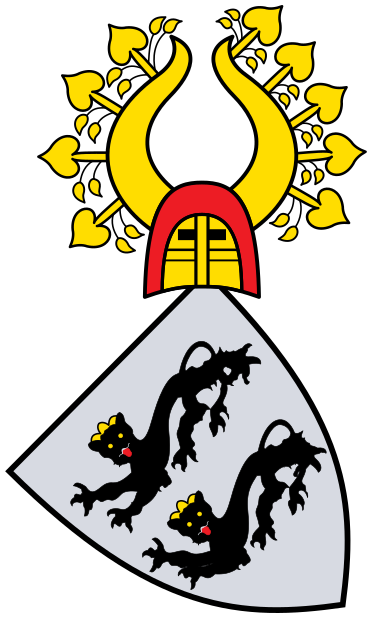
Take the arms of Hohenlohe. The shield bears two black leopards on silver, while the crest has two silver buffalo horns ornamented with golden linden branches. The branches are an important part of the example, because the horns are not just blank objects that happen to be the same color as the shield. They have their own design. Yet the entire achievement is recognizable as a coherent family identity.

The ancestral arms of the von Bismarck family also use a pair of horns, providing another example of how naturally the form sits above a helmet.

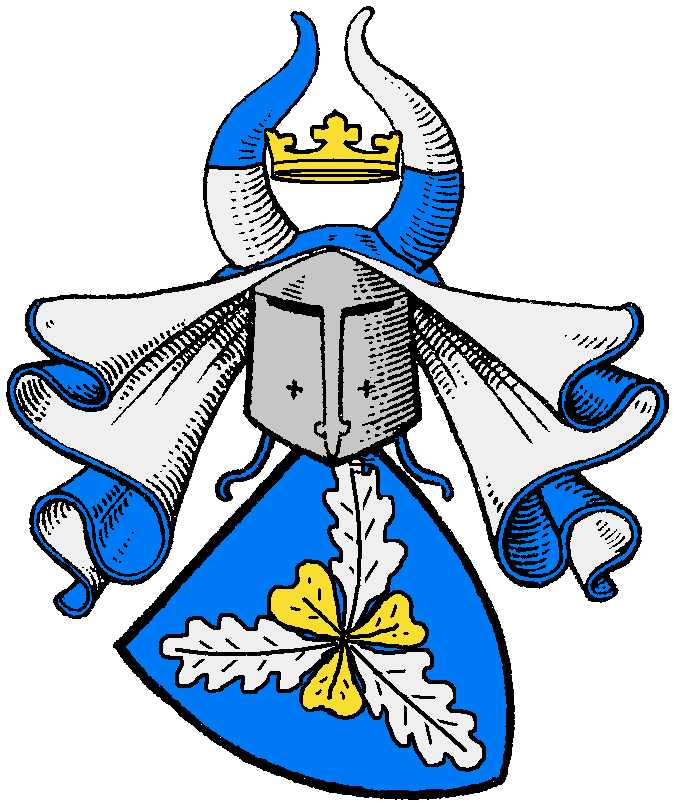
The horns are not an explanation of the charges in the shield. They are a second means of identifying the same family.
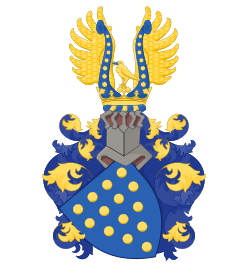
We can go considerably further. The Bülow arms have fourteen golden roundels on a blue shield. Above it are two blue horns, each decorated with seven golden roundels, with a bird and wings appearing in the composition. The arrangement is rather elaborate, but it demonstrates the underlying principle neatly. The distinctive elements of the shield can be distributed across an entirely different shape without ceasing to identify the family.

This is related to the use of identifying colors in clothing, horse furniture, banners, and other displays, though heraldic tinctures and a household’s livery should not simply be treated as interchangeable terms. The Genealogical-Heraldic Society of Regio Basiliensis notes that crests frequently repeat a charge, color, or division from the shield. A pair of horns provides a particularly convenient way to accomplish that.
There is an important distinction here. The crest is not merely a convenient thing to put above the arms after somebody has decided how to draw them. It can be hereditary and recorded in its own right. Two families might have similar shields but different crests, or retain a longstanding crest through considerable changes in how the achievement is illustrated. The horns offer artistic freedom within the limits of an established identity.
The old Geheimes Ehrenbuch der Fugger, produced in the workshop of Jörg Breu the Younger in the mid-sixteenth century, is a particularly good illustration of what heraldic artists could do with this freedom. The manuscript is full of decorated arms, and the elaborate crests have become part of the entire composition. The horns are no longer simply equipment to be constructed and fitted onto a knight’s helmet. They are part of an artistic language that can be understood without anyone actually wearing them.

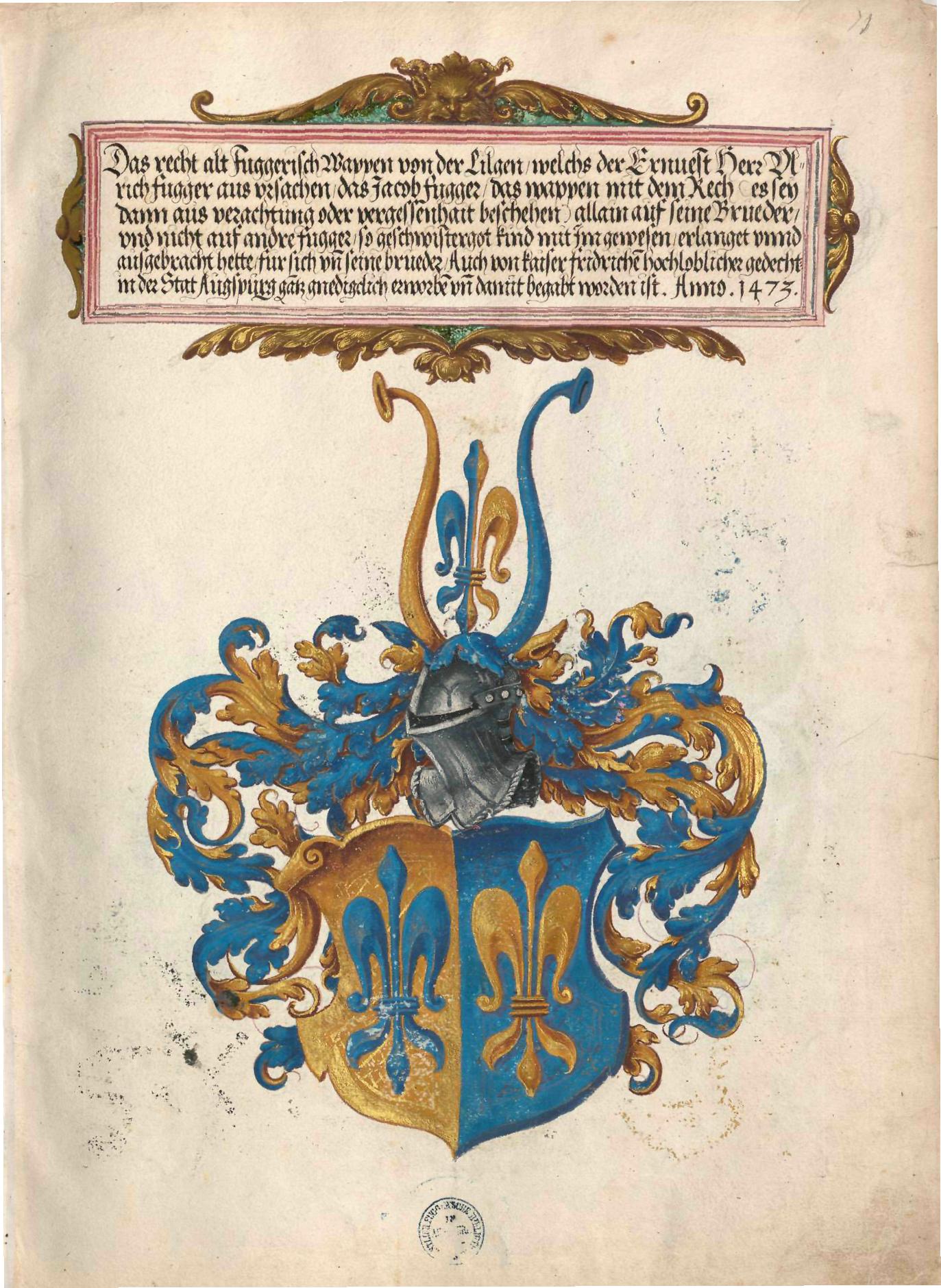
This also helps explain why the German horn crest survived when other helmet ornaments did not become nearly as common. The horns provide height and a recognizable silhouette, but they can also accommodate almost any combination of tinctures and subsidiary ornaments. There are limits to what an artist can do before changing the heraldic identity, of course, but there is considerable room within those limits.
And No, These Are Not Viking Helmets
We also need to address the obvious comparison with Vikings. The popular image of a Viking warrior wearing a helmet with two great horns is so familiar that any horned helmet risks being mistaken for one. Unfortunately, that is not an especially good description of Viking military equipment.
There really were horned helmets in prehistoric Scandinavia. The famous Viksø helmets from Denmark have been dated to around 1000–900 BCE, many centuries before the Viking Age. Aarhus University discusses the dating and the wider Bronze Age context. These helmets probably had a ceremonial function. There are also horned figures in some early northern representations, but neither observation shows that Viking warriors generally wore horns into battle. The National Museum of Denmark makes this distinction clear.
Much of the familiar horned Viking image developed through nineteenth-century Romantic art and theatrical costume, including productions associated with Wagner. Those are interesting traditions, but they do not explain the German heraldic crest. For that, we have something considerably better than a speculative connection. We have the surviving helmets, the early armorial manuscripts, and the subsequent development of the crest in heraldic practice.
The horns that became so familiar in German heraldry belong to the medieval tradition of the tournament and the inherited armorial achievement. That is a sufficiently good story without recruiting the Vikings to help.
The Helmet That Never Quite Went Away
Medieval tournaments changed and eventually declined, but heraldry continued to record family identities through seals, manuscripts, monuments, and printed armorials. The horns no longer had to be constructed and balanced on somebody’s head to function as a crest. Once the heraldic object lived primarily on paper, an artist could make it taller, more elaborate, and more decorative, provided the inherited design remained recognizable. That helps explain both the variety of German horns and the occasional confusion over whether they were supposed to belong to buffalo or elephants.
But it would be a mistake to conclude that putting identifying devices on sporting helmets disappeared along with medieval tournaments. We still do it. Consider the Baltimore Ravens’ football helmets: a raven on the side identifies the team, even though the object is now a modern protective helmet rather than a medieval great helm. Players, spectators, and television viewers all recognize the emblem. It may not be hereditary heraldry, but it is the same practical design problem. A helmet covers the head; its exterior provides a convenient, visible place to say who is wearing it.
There is an even better example. In 1948, Los Angeles Rams halfback Fred Gehrke painted a pair of golden ram’s horns on the team’s blue helmets. The Pro Football Hall of Fame identifies them as the first modern helmet emblems in professional football. The Rams’ own history confirms the story. As far as historical coincidences go, replacing a medieval tournament helmet decorated with buffalo horns with a modern sporting helmet decorated with ram’s horns is almost suspiciously convenient.
And the Rams did not leave the horns alone. They stylized them, simplified them, and adapted them to the curve of a modern protective helmet. That is not a departure from heraldry. Stylization is one of the things that makes heraldry work in the first place. Consider the heraldic lion, which is regularly shown standing on one hind leg with exaggerated claws and tongue, and which may be rendered in colors no lion has ever possessed. Nobody mistakes a lion rampant for a field guide illustration, but nobody mistakes the animal either. The University of Notre Dame’s heraldic dictionary explains the distinction between the animal as it exists in nature and the conventional form it takes in heraldry.
The modern Rams helmet works the same way. A sweep of stylized horns around a helmet is sufficient to identify the team without requiring anything remotely resembling a pair of actual ram’s horns. In much the same way, a pair of German Büffelhörner could be lengthened, widened, decorated, and eventually made to look like elephants’ trunks without losing their established heraldic identity.
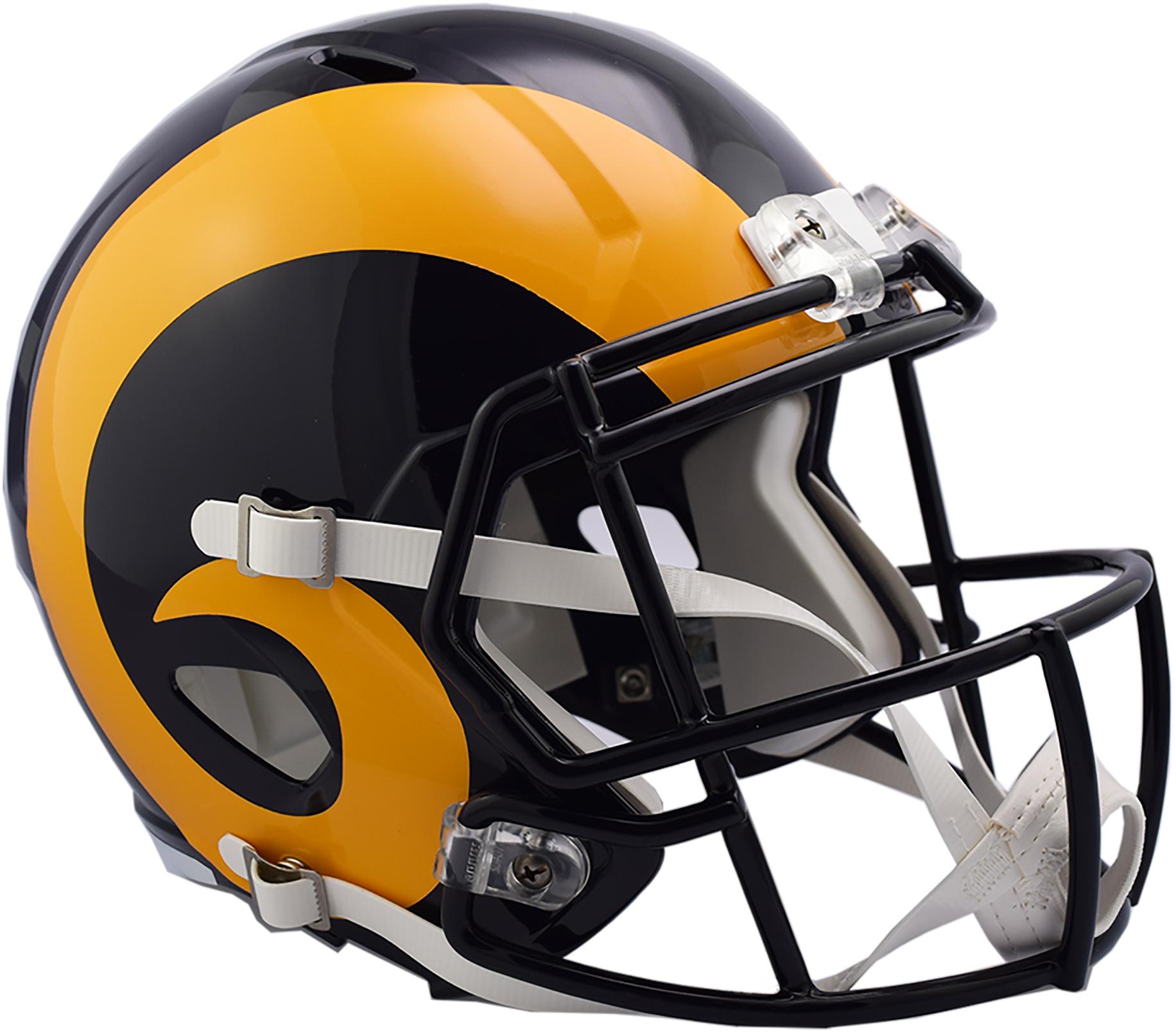

This does not mean that Fred Gehrke was reviving a German heraldic tradition, or that modern football helmets descend in an unbroken line from tournament crests. It means that the same problems of visual identity produce similar solutions, and that both traditions rely upon stylization to make the result recognizable. The materials, rules, and identities have changed. The visibility of a helmet, and its usefulness as a place to display identity, have not.
The Büffelhörner remain interesting for another reason, too. The horns began as objects that could be fitted to a helmet, became inherited symbols, and continued to be recognized long after the equipment that first carried them had become obsolete. In that respect heraldry separates the identity from any single physical realization of it. An artist can draw the horns quite differently from the last artist and still depict the same crest.
Besides, two enormous horns above a helmet look fantastic. Apparently, we still think so.
And this is why I say sports announcers are just modern heralds.