
The United States maintains thousands of buoys. They are numbered, charted, lit, and serviced on a schedule. Every one of them says some version of the same thing, which is that the channel is here and you are there. Exactly one buoy in American waters says something else. On the last Tuesday of July, I watched the Coast Guard put it in the water for the forty-sixth time.
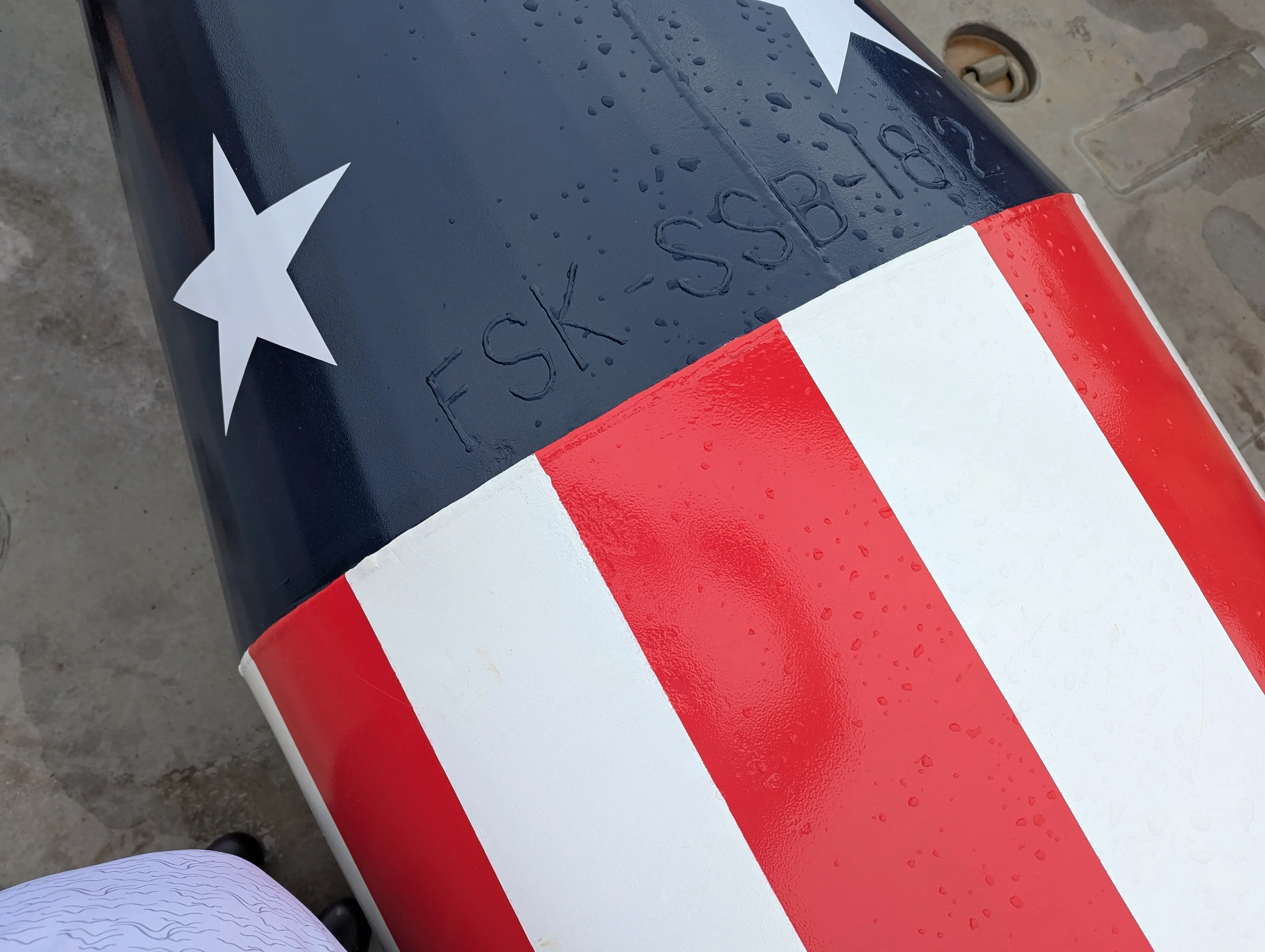
The Francis Scott Key Memorial Buoy marks the spot in the Patapsco River where an American truce ship lay at anchor during the bombardment of Fort McHenry in September 1814. Key stood on that deck for twenty-five hours, watched the shells arc over the water, and wrote the poem that became the national anthem. The buoy is painted for the occasion. Fifteen white stars ride a blue cone above red and white stripes, and the stripes wrap the barrel in an even count because an alternating pattern around a closed curve cannot do otherwise. The flag is a rectangle. The buoy is a solid of revolution. The paint quotes the idea of the banner in the only grammar the geometry permits.
The designation welded into the hull does the rest of the work. The buoy is FSK-SSB-1812. The man, the song, and the war are compressed into one serial number, and it is the only aid to navigation I know of whose designation is a date. It is also, strictly speaking, not an aid to navigation at all. The buoy appears on the chart when it is set each summer, because a steel object moored in a shipping channel must be charted whether or not it means anything. But it marks no shoal and guards no channel. Every other buoy in the Patapsco says steer here. This one says remember.
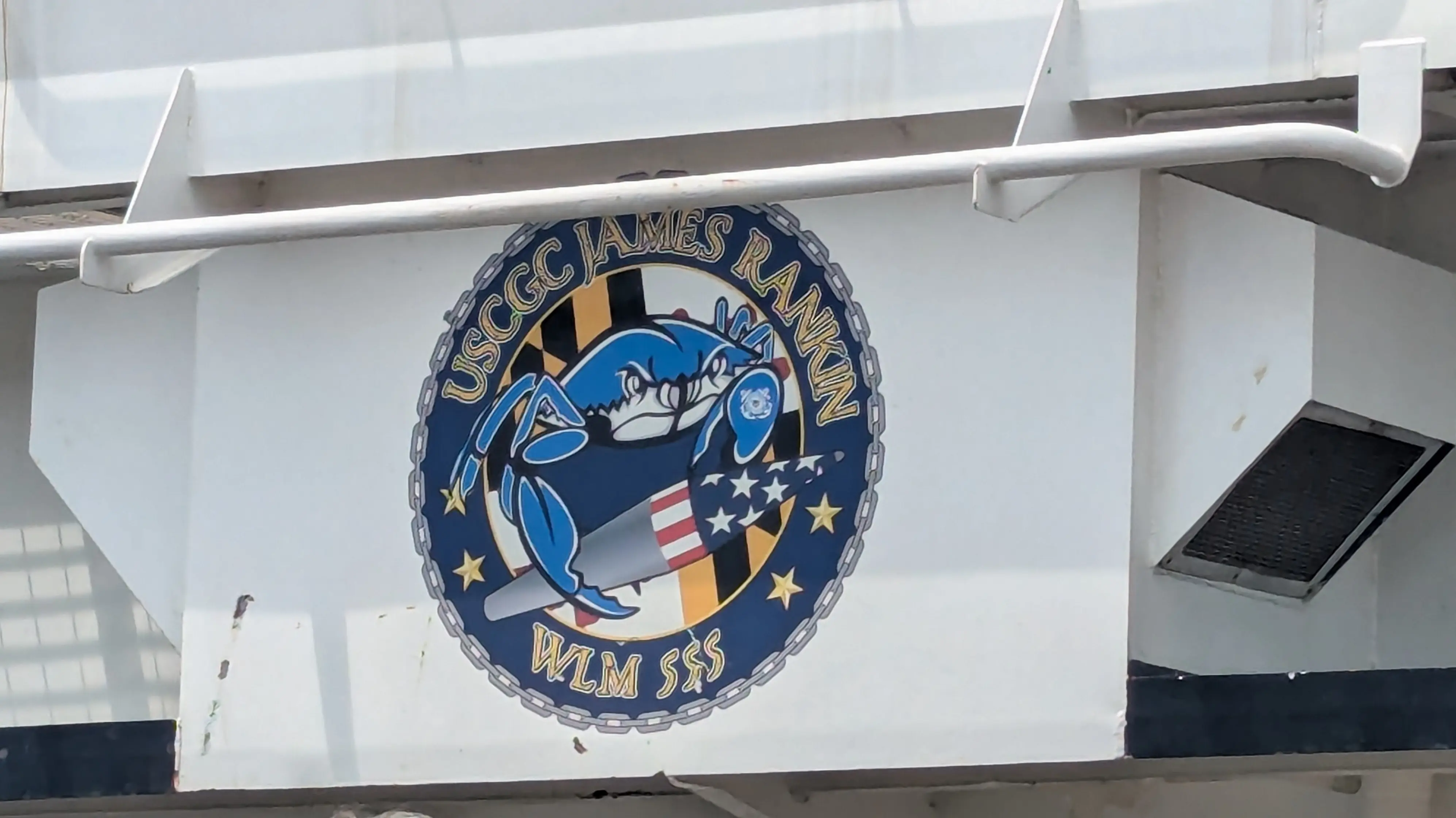
Only July 28th, I rode down from the Coast Guard Yard aboard USCGC James Rankin, the Baltimore-based buoy tender whose crew performs the commissioning each year. The Rankin wears its assignment openly. The ship’s crest shows a Maryland blue crab clutching the Key buoy itself, and the crane block that lifts the buoy is painted with the national flag on one cheek and the Maryland flag on the other, so the lift is federal or state depending on where you stand. At the masthead the crew flies the pennant of the United States Lighthouse Service, an agency that ceased to exist in 1939. The buoy tender fleet descends from the lighthouse tenders, and the pennant asserts an ancestry older than the Coast Guard itself. I went for a boat ride and found a complete heraldic system.
The ceremony was held at the buoy station, which sits within sight of the Francis Scott Key Bridge. The bridge fell in March 2024 and its replacement is rising now. The severed approach spans still hang in the air, and all morning the pile drivers setting the new foundations kept up an intermittent concussion across the water. The sound sharpened when we swung into line of sight and dulled when the deckhouse stood between us and the work, and it was impossible to stand there, at the anchorage where Key listened to the guns, without hearing the rhyme. Rhythmic percussion over the Patapsco, except this time the city is building rather than burning. Nobody aboard remarked on it. Baltimore has already absorbed the sound into ordinary time.
The commissioning itself divides into ceremony and evolution, and the transition between them is the honest heart of the event. The speeches end, the guests are moved to the rails, and the buoy deck reverts to the working party. Hard hats go on. The mooring chain pays off the drum link by link. The sea fastenings come loose, and I noted with satisfaction that the crew ran the hardware with the same cordless impact driver that sits in my garage. The memorial does not ride on ceremony. It rides on DeWalt. Then the crane named Keeper of the Bay took the strain, the cone swung out over the rail at an improbable angle, fifty phones rose in unison, and FSK-SSB-1812 went into the Patapsco upright and serene, six thousand pounds of counterweight doing invisible work below the waterline.
The origin of all this is worth knowing because it explains why it works. In 1972 a local history advocate named Ben Womer pushed to mark the truce ship anchorage, and volunteers from the Maryland Naval Militia painted a buoy and placed it in the river. It did not last. A non-navigational object in federal waters with no maintenance plan is, from the system’s point of view, debris with good intentions, and the Coast Guard removed it. The solution, formalized in 1980, was not to make an exception to the system but to enroll the memorial in it. The buoy received a designation, an annual servicing schedule, and a tender assigned to the duty. That is the whole lesson, and it generalizes well beyond the harbor. The bridge was the monumental commemoration, a million tons of steel across the river mouth, and it proved mortal. The buoy is the modest one, pulled every winter, repainted, reset, and it has now outlived the bridge. Permanence is a claim. Maintenance is a practice. In American waters, even remembrance requires a maintenance plan.
One more correction belongs in the record, because the scholarship is recent and it is ours. Generations of accounts put Key aboard HMS Minden, a ship that was never in North American waters during the war. Key was never a prisoner on a British ship at all. He and John S. Skinner, the American agent for prisoners of war, negotiated aboard HMS Tonnant, were held briefly aboard HMS Surprize, and watched the bombardment from their own American truce vessel. Research published last year by Louis F. Giles for the Society of the War of 1812 in the State of Maryland worked through Skinner’s accounts, the Surprize muster rolls, and Baltimore shipping records to identify that vessel as the sloop Stephen Decatur, a working Baltimore-to-Norfolk packet named for a living naval hero. Not a warship. A mail boat with a fast hull and a famous name. The story gets smaller, more local, and more Maryland the closer you look, which is how you know you are getting near the truth.
I spent twenty years crossing the Key Bridge and I spent two years, at the start of my career, working for a Beltsville company that taught buoys to send email. I have now stood on a buoy deck and watched the opposite end of that spectrum go over the side, a buoy with no instruments, no telemetry, and no payload except meaning, and I think it may be the most articulate object in the harbor. When the Rankin pulled away, the cone sat alone in open water with the new bridge rising behind it, the smallest thing in the frame and the only one that will be renewed every year forever.
The water smells sweeter out there, where the river opens toward the bay. It sharpens as you run back up into the working harbor. The buoy rides in the sweet part. It smelled like summer on the bay the morning Key watched the flag come up over the fort, and it smelled like summer on the bay on Tuesday, and the paint was still drying on the newest coat of an old promise.