
A contemporary appointment in an order whose nineteenth-century history is documented separately below. The record is strongest when those two things are not blurred together.
My Appointment

The appointment record states that H.R.H. Princess Owana Kaʻōhelelani, Head of the Royal House of Hawaiʻi and Grand Master, appointed James Patrick Howard II Knight Commander of the Royal Order of the Star of Oceania in Hilo, Hawaiʻi, on 17 March 2024.
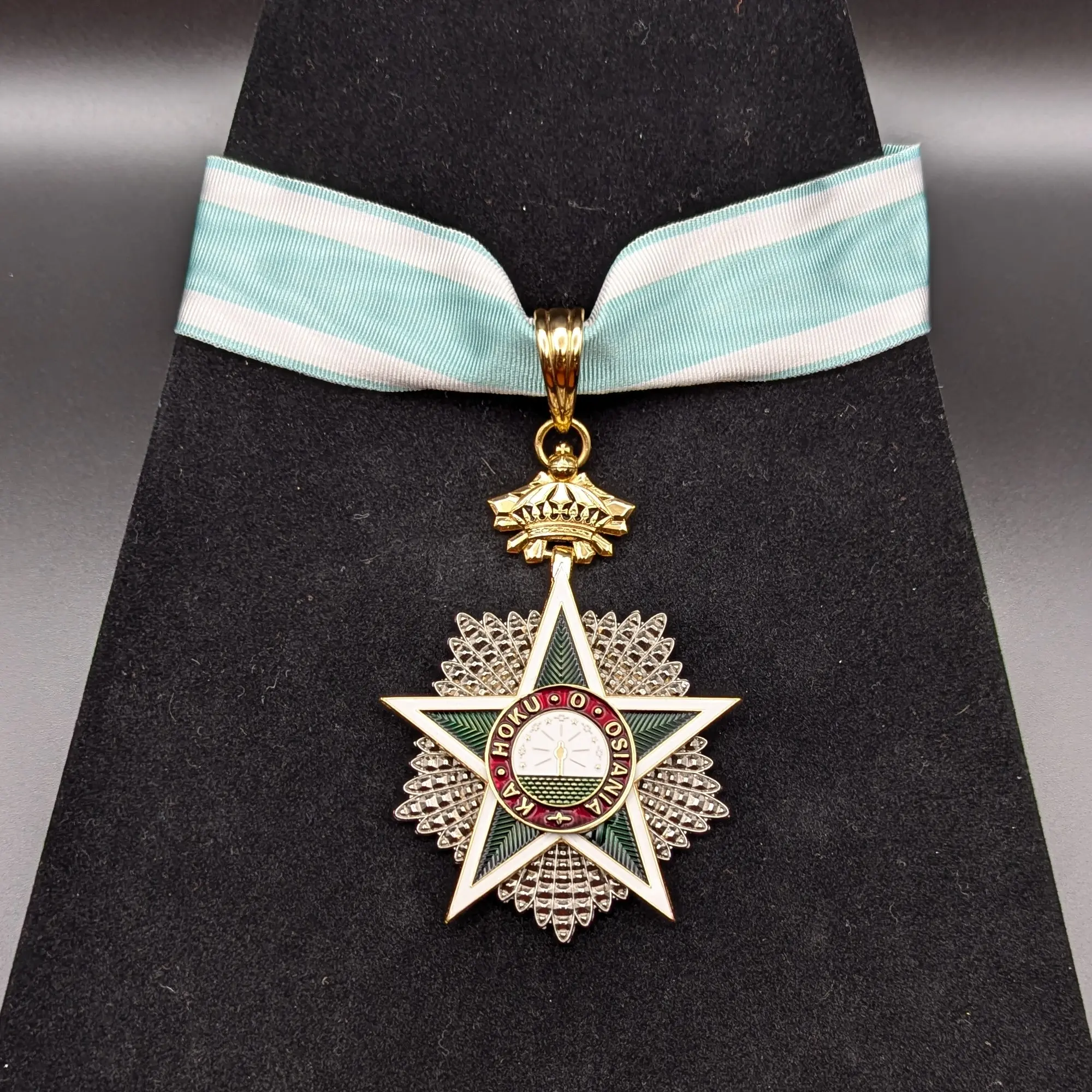
That records a specific contemporary appointment. It does not, by itself, decide every question that can be asked about modern Hawaiian dynastic succession or the legal status of a present-day order. Those are separate questions, and this page keeps them separate.
The Historical Royal Order

King Kalākaua founded the historical Royal Order of the Star of Oceania on December 16, 1886. Its Hawaiian name is recorded as ʻOihana Kea Hoʻohanohano Aliʻi o ka Hōkū o Osiania; surviving examples are held by ʻIolani Palace and the Smithsonian’s National Museum of American History.
The 1886 statutes described an order for distinguished service to the sovereign or state and for advancing Hawaiʻi’s name and influence among Pacific and Indian Ocean communities and neighboring regions. The contemporary statutes are catalogued in the University of Hawaiʻi’s Ulukau digital library. That purpose is unusually specific: this was a Hawaiian state order designed for a diplomatic project, not a generic award for good works.
The historical order had five principal grades - Grand Cross, Grand Officer, Commander, Officer, and Companion - as well as gold and silver medals. The grade of my 2024 appointment, Knight Commander, should therefore not be read as silently reproducing an 1886 grade. It belongs to the present issuer’s revised system.
Kalākaua and the Pacific Confederation
The Order made sense within Kalākaua’s wider attempt to increase Hawaiʻi’s influence and build cooperation among independent Pacific polities at a moment when European and American powers were extending colonial control through the region. The order was one tool among several: diplomatic missions, treaty making, and the use of court honors to mark relationships with chiefs and governments.
Hawaiian diplomacy in Sāmoa provides the clearest example. John E. Bush’s mission reached Apia in 1887, and King Malietoa Laupepa entered into a treaty of political confederation with Hawaiʻi. The Bishop Museum’s account of the treaty places the Order, the treaty, and the voyage of Kaimiloa together as parts of that effort. The agreement did not produce a lasting confederation. Colonial pressure and local politics rapidly constrained the project, but they explain why Kalākaua created this particular order when he did.
For a scholarly introduction to the order’s relationship to Hawaiian international policy, see Lorenz Gonschor’s Ka Hoku o Osiania and Kealani Cook’s accessible account of Kalākaua’s Polynesian confederacy.
Insignia and Grades
Historical pieces in the ʻIolani Palace collection include a Commander example of the nineteenth-century order. Scholarly accounts attribute the historical insignia design to court artist Isobel Strong. The star, enamel, and central maritime device are features of the historical object; the colors and form were part of the order’s own visual language, not a later attempt to make it look antique.
The contemporary insignia shown above is the insignia issued with my appointment. It should not be assumed to be an exact reproduction of every nineteenth-century grade. The distinction is useful rather than embarrassing: the historical order can be documented through museum objects and its statutes, while the present instrument documents a contemporary ceremonial appointment.
1893 and the End of the Monarchy
Queen Liliʻuokalani was overthrown in January 1893 by the Committee of Safety, with the support of United States Minister John L. Stevens and a contingent of U.S. Marines from USS Boston. The Committee proclaimed a Provisional Government; the Republic of Hawaiʻi followed in 1894. The National Archives’ account summarizes that sequence, and its record of the 1898 annexation resolution marks the subsequent annexation by the United States.
After the overthrow, the Star of Oceania no longer functioned as an order of a reigning Hawaiian state. I have not found a primary instrument that supports calling it legally “abolished,” so that stronger claim does not appear here.
The Contemporary Order
The organization headed by Owana Kaʻōhelelani Salazar maintains a contemporary order under the historical name. Its own Order page says that the order has been reestablished and describes its current activities and grades. That is the issuer’s account of its institution.
The present website does not provide a reliable date for reestablishment, and available secondary references conflict with an older date once used here. Rather than repeat an unsupported year, this page says only that the contemporary house later reestablished an order under the same name.
The issuer’s published list expressly identifies KCRSO as the postnominal for a male Knight Commander. That verifies its use for the contemporary order; the preserved /kcrso redirect remains a compatibility route, not evidence that the same abbreviation belonged to the 1886 system.
The Modern Dynastic Context
Owana Kaʻōhelelani Salazar claims headship of the Royal House of Hawaiʻi through the Laʻanui/Keōua Nui line. Her organization’s description of the contemporary order and her role is properly treated as the issuing house’s position. Descent from a historical line and a modern claim to headship are different propositions; contemporary Hawaiian royal-house succession is not resolved by the nineteenth-century materials cited above. This page does not adjudicate between competing modern claims.
That caution does not erase my appointment. It is a real contemporary honor issued by the organization that describes itself in those terms.
Diploma and Insignia
The diploma is not reproduced here. Its material appointment lines name James Patrick Howard II as Knight Commander of the Royal Order of the Star of Oceania, with the date and place 17 Malaki 2024 ma ka moku o Hilo ma Hawaiʻi.
English translation
Her Royal Highness Princess Owana Ka’öhelelani, Head of the Royal House of Hawai’i, hereby issues this Charter to affirm and uphold our fundamental values and virtues. It is with a deep commitment to the pursuit of true goodness that I address you,
James Patrick Howard II
Knight Commander
Royal Order of the Star of OceaniaIn your official capacity and as part of your inclusion, you may wear the honors representing your distinguished merit and noble character. In recognition of these attributes, this Diploma was expediently issued on March 17, 2024, in the district of Hilo in Hawai’i.
Sources and Further Reading
- ʻIolani Palace, Royal Orders collection and its Royal Order of the Star of Oceania collection record.
- Smithsonian National Museum of American History, Royal Order of the Star of Oceania.
- University of Hawaiʻi Ulukau library: The Hawaiian Kingdom, vol. 3, which catalogs the 1886 statutes.
- Bishop Museum: Hawaiian-Samoan Treaty of Confederation.
- National Archives: the 1897 petition against annexation and the 1898 annexation resolution.
- Crown of Hawaiʻi: contemporary Order page - used only for the present issuer’s own descriptions, modern grades, and postnominals.