

Personal armorial record
Arms at a Glance
- Granting authority
- Office of the Chief Herald of Arms of Malta
- Letters Patent
- G0102
- Date
- 1 May 2024
- Motto
- Ir-rieda biss tmexxi l-qalb
Heraldry

At its core, heraldry began as a system of identification. Over centuries, it evolved from simple insignia into the complex art and science of designing, displaying, and regulating coats of arms. As we recognize it today, the heraldic tradition emerged in the early twelfth century, primarily serving the practical purpose of distinguishing combatants who were otherwise obscured by armor on the battlefield. This necessity gave rise to the role of the herald, individuals clad in distinctive tabards who conveyed messages and issued challenges on behalf of sovereigns or lords. They were protected from harm and charged with maintaining detailed knowledge of armorial symbols within and beyond their jurisdiction.
Over time, heralds gained sovereign-backed authority to grant coats of arms officially. Although the decline of armor in warfare reduced heraldry’s original function, it had already secured a permanent place within the social fabric. Coats of arms became symbols of identity, status, and continuity. They were granted to the aristocracy and later to notable figures seeking distinctive forms of identification in a largely illiterate society.
In the modern era, heraldry has transcended its martial origins and now serves as a form of personal, familial, civic, and institutional identity. Its status varies by jurisdiction. Some countries maintain public heraldic authorities that grant or regulate arms; in others, including the United States, original arms may be assumed under customary practice; and elsewhere heraldry operates principally through custom and private record. The Maltese grant described on this page belongs to the first category.
Heraldry in Malta
The Republic of Malta possesses a rich European heraldic tradition, reflected in the arms of its noble families, the historic Order of St. John, and numerous ecclesiastical and civic institutions. Heraldry in Malta appears on churches, corporate emblems, schools, and municipalities, forming part of the visual language of national identity.
For many years, heraldic emblems developed locally without centralized oversight. This changed with the establishment of the Office of the Chief Herald of Arms of Malta at Fort St Elmo in Valletta. The appointment of Count Charles Gauci as the inaugural Chief Herald of Arms in 2019 marked the beginning of the centralized office.
Heritage Malta describes the Office as the body that regulates new heraldic emblems in Malta, devises and grants personal and corporate arms, and registers arms already used locally or granted by appropriate foreign authorities. That formal Maltese framework controls the status of G0102; it is not presented here as a universal model for every heraldic jurisdiction.
My Grant of Arms
I received a grant of arms from the Office of the Chief Herald of Arms of Malta, formalized through Letters Patent numbered G0102, issued on May 1, 2024. The Letters Patent grant the shield, the helm and mantling, the martlet crest upon its wreath, and the motto upon an escroll. They authorize the arms to be borne in shield or banner or otherwise by me and my descendants, with due and proper differences, and record the bearings in the Archives of the Office under G0102/2024.
The banner rendering and the other devices shown later on this page were developed from the arms after the grant. They should not be confused with the elements expressly granted in the Letters Patent.
Letters Patent

Or you may download the PDF here.
Gazette Notice
The earlier publication in the Gazzetta tal-Gvern ta’ Malta was not notice of an already completed grant. Notice No. 231 in issue 21,194, dated February 16, 2024, states that the listed persons had applied for the provision or registration of heraldic arms. Issued under article 9(2) of the Heraldry and Genealogy Regulations 2021 (S.L. 445.07), it opened a 21-day period for valid and cogent representations for or against the application. The documentary sequence was therefore: publication of the application, the period for representations, and then the issue of Letters Patent G0102 on May 1, 2024.
The notice is available in the official Government Gazette repository and in this site’s archived copy of the complete February 16, 2024 issue.
Bound Letters Patent
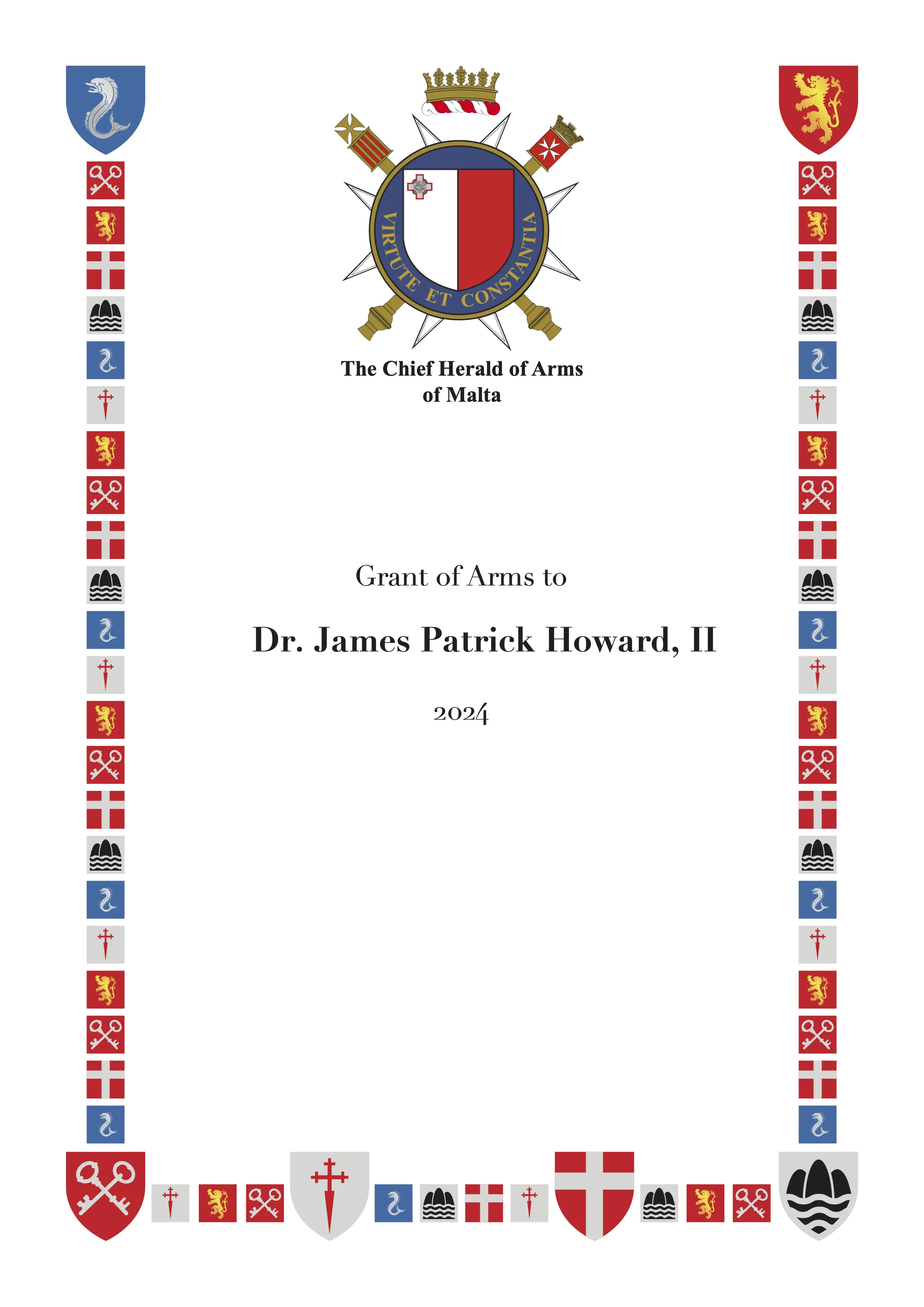
The Office also supplied a bound A4 presentation of the same Letters Patent. It contains the same petition, grant, blazon, motto, signatures, and archive registration as the single-sheet A2 instrument, rearranged across nine pages for handling and reference. It is an alternative documentary presentation of G0102, not a second grant or another registration.
You may download the PDF here.