
The Letters Patent permit the arms to be borne in banner form, although the specific banner artwork shown below was prepared later. The seal, badges, standard, kamon, livery flag, and cockade are later personal designs derived from or associated with the arms. None was separately granted by the Maltese authority.
Banner

The heraldic banner is a square flag displaying the shield alone. Unlike a standard, which combines several armorial components in a longer format, the banner reproduces only the escutcheon.
The blazon of the banner is:
A banner of the Arms
This format omits the helm, crest, mantling, and motto. The Letters Patent expressly allow the arms to be borne in banner form; this particular square rendering was prepared after the grant and was not separately granted. Its one-to-one proportions distinguish it from the longer standard and from the gold, blue, and white livery flag shown below.
Seal
Historically, personal seals provided a reproducible device for authenticating documents and identifying the person responsible for them. Armorial seals naturally incorporated heraldic devices because the arms already served as a formal visual identity. A modern private seal continues that tradition as a personal mark for documents and correspondence, although its armorial character does not by itself give it legal authentication powers.
These two monochrome renderings place the shield and martlet crest within a circular design. The surrounding legend gives a Latinized form of my name, James Patrick Howard II, and repeats the Maltese motto Ir-rieda biss tmexxi l-qalb. Both versions are recognizably derived from the same armorial identity: the tetrahedron pierced by a sword appears on the shield, the martlet stands above it on the wreath, and the motto encircles the composition. One version uses dense heraldic hatching and engraved texture; the simplified version reduces that treatment for clearer reproduction at smaller sizes.


The arms are the heraldic design defined by the blazon; a badge is a separate personal emblem; and a seal is an application of personal identity designed for impression or reproduction on documents. These additional commissioned renderings are by Quentin Peacock, a professional digital heraldic artist and Craft Member of the Society of Heraldic Arts whose work also includes the Fairbairn-style crest shown above. The seal is a later personal design and is not part of Letters Patent G0102.
English Heraldic Badges

Two heraldic badges are associated with my armorial bearings, each combining core elements from the arms into compact, emblematic forms. These badges follow the tradition of English armory, where personal devices were historically used for identification in less formal or non-armorial contexts, appearing on retainers’ clothing, seals, standards, household plate, and architecture.
The primary badge places the martlet from the crest before an inverted sword drawn from the shield.
The blazon of the primary badge is:
A sword inverted Or hilted Azure surmounted by a martlet Sable.
This badge was adopted after the Maltese grant. It is derived from granted components but is not itself included in the Letters Patent.
The secondary badge places the blue tetrahedron from the shield beneath two golden swords in saltire.
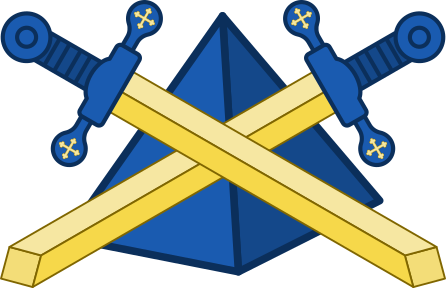
The blazon of the secondary badge is:
A tetrahedron Azure surmounted by two swords in saltire Or, hilted Azure.
Both badges are later personal devices. They may be used in heraldic or para-heraldic settings, but neither was independently granted or registered by the Maltese authority.
Scottish-Style Crest Badges
Guidance from the Court of the Lord Lyon distinguishes several forms of Scottish crest display. A clan member may wear the chief’s crest and motto inside a strap and buckle. A Scottish armiger whose arms are recorded in the Lyon Register, or inherited under Scots heraldic law, may display the armiger’s own crest upon its wreath, coronet, or chapeau, or within a plain circlet, and may add one silver eagle feather.
My arms were granted in Malta and have not been matriculated in the Lyon Register. The two pieces shown here are therefore Scottish-inspired adaptations, not evidence of Scottish armigerous status, entitlement to regulated Scottish insignia, or recognition by the Lord Lyon.
The strap-and-buckle version adapts the crest and motto to the visual form associated with Scottish clan badges. The feathered version explores the armiger-style convention. Both are preserved here as comparative personal designs rather than as regulated Scottish insignia.
Irish Crest Badge
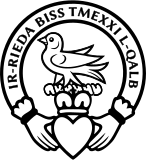
While Scottish heraldry developed the strap-and-buckle crest badge as a formalized declaration of clan loyalty, no such parallel ever existed in Ireland. The social structures of Gaelic Ireland centered on kinship and territory rather than corporate “clans” in the Scottish sense, and Irish heraldry never adopted a codified badge system.
In the modern era, however, an alternative has emerged: the substitution of the Claddagh ring, two hands clasping a crowned heart, as the surround for a crest badge. This adaptation is a late twentieth- and early twenty-first-century invention, designed to provide an “Irish equivalent” to the Scottish clan badge. It is most often used in diaspora contexts, where Irish identity is celebrated through popular symbols.
Though not grounded in historic Irish heraldic law or custom, the Claddagh crest badge is sometimes used as a modern para-heraldic emblem. I have included an Irish-style crest badge for my own arms, framed within a Claddagh, while recognizing that it is neither an official Irish heraldic category nor a form of legal recognition.


Standard
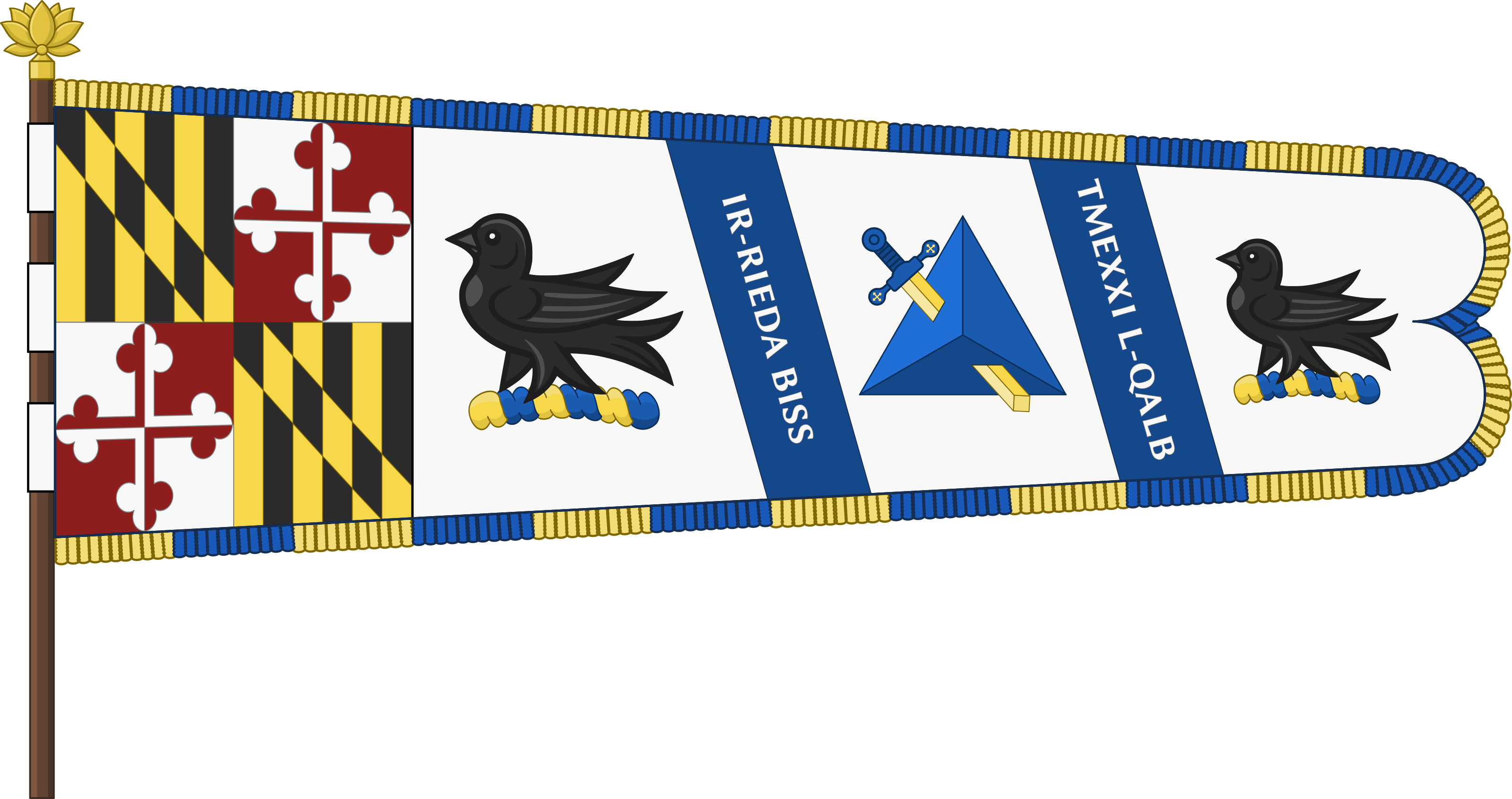
A heraldic standard is a long, tapering flag that combines several elements, often including a badge, crest, motto, and livery colors. It differs from a banner of arms, which reproduces the shield as a flag.
This is a modern personal standard inspired by historical standard formats. I placed the quartered Calvert and Crossland design used by Maryland at the hoist as a personal reference to the state and my family’s Maryland roots. That choice should not be read as a claim of feudal allegiance or as a separately granted heraldic element.
The full blazon of the standard is as follows:
A standard, the hoist bearing the arms of Maryland; the fly per fess Argent, charged with the Crest between two representations of the Badge, all separated by two bends Azure inscribed with the Motto in letters Argent
The fly combines the crest, two representations of the badge, and the motto Ir-rieda biss tmexxi l-qalb. The standard was designed and adopted after the Maltese grant; it is a personal derivative work and is not part of G0102.
Kamon

This kamon (かもん) is a modern creation, inspired by my existing coat of arms but developed independently through collaboration with several artists and designers familiar with Japanese heraldic tradition. It draws from the motif known as けんむすびかりがね (剣結び雁金), a combination of stylized wild geese (かりがね, 雁金) and sword knots or blades (けん, 剣). The final form includes three birds interwoven with blades in a pattern that is both elegant and unprecedented in traditional mon (もん) surveys, according to experts I consulted.
While kamon (かもん) historically emerged as family identifiers during Japan’s Heian period, they have always left room for aesthetic innovation, especially in modern reinterpretations. This design does not reflect any existing Japanese family emblem but is instead a thoughtful, respectful fusion of form and meaning, an abstract representation that nods toward both martial symbolism and migratory grace.
To me, the arrangement of the elements, three geese and three swords, each spaced 60 degrees apart, suggests movement, balance, and symbolic interplay. The design alternates かりがね (雁金) and けん (剣) in a circular configuration, such that a goose sits at the top and a sword anchors the bottom. This symmetry creates a sense of poise and quiet dynamism. While the symbolism is personal and interpretive, the rotational balance and alternating motifs give the かもん (家紋) a feeling of motion and intention, expressive without being literal.
This kamon (かもん) is not a replacement for my coat of arms, but rather a sibling to it, a cross-cultural expression rooted in dialogue, design, and a shared appreciation for heraldic language. It is a modern personal adaptation, not a historical Japanese family emblem, an official Japanese heraldic category, or a form of recognition by a Japanese authority.
Flag

The flag of my liveries is composed of three vertical stripes of equal width, arranged from hoist to fly in the order gold, blue, and white. This tricolor format offers a clean, modern articulation of the livery colors drawn from my armorial bearings. It is not a banner of arms and does not replicate any heraldic charges; rather, it serves as a livery flag, a visual marker of affiliation, presence, and identity.
Unlike traditional banners of arms, which transcribe the shield directly into flag form, the livery flag is more flexible in use. It may be flown in both formal and informal contexts, serving as a field sign, household standard, or traveling emblem. Its purpose is to convey recognition, not blazon: a coherent expression of the armiger’s established colors, suitable for display where the full achievement might be impractical or excessive.
The vertical arrangement offers a balanced and dignified aesthetic, consistent with both heraldic and vexillological principles. Though the colors themselves do not carry specific symbolic meaning apart from their use in the arms, their combination is distinctive and immediately recognizable. When rendered in cloth or drawn in miniature, the gold–blue–white tricolor serves as a quiet but unmistakable extension of heraldic presence.
The livery flag was adopted after the grant. It is a modern personal design, not a banner of the arms and not part of Letters Patent G0102.
Cockade

A cockade is a decorative rosette historically used to show allegiance, affiliation, or identity. This personal para-heraldic version consists of three concentric circles in white, blue, and gold, arranged from the outside inward. It was adopted after the Maltese grant and has no separate institutional or legal status.